Introduction:
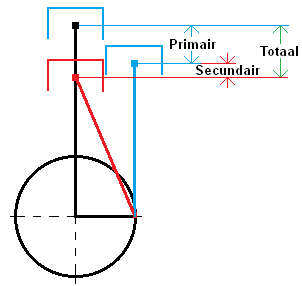
The up-and-down (translating) movement of the piston is converted into a rotary motion by the crank-connecting rod mechanism. The piston moves straight up and down in a single line. This is called the primary piston movement. However, the connecting rod does not only move up and down, but also sideways. Due to the lateral movement of the connecting rod, the piston will cover a slightly greater distance. In addition to this greater distance, the piston has also reached its highest speed of motion at this point. This extra distance is called the secondary piston movement.
The piston movement is shown in the image. The upper blue piston indicates where TDC (Top Dead Centre) is. The blue piston on the right in the middle indicates the distance of the primary piston movement (that is, where the connecting rod has not yet become inclined). The lower red piston indicates the extra distance created by the rotation of the crankshaft and the inclined position of the connecting rod; this is the secondary piston movement.
At the moment the crankshaft has rotated 90 degrees, the piston’s speed of motion is at its highest. The secondary piston movement results in a greater distance travelled. By adding the distance of the secondary movement to that of the primary movement, the total distance travelled by the piston can be determined.
The ratio between the length of the crankpin and the length of the connecting rod determines the magnitude of the secondary movement. The secondary piston movement also affects the piston speed and piston acceleration.
Primary and secondary piston movements:
In this section, the primary and secondary piston movements are shown in graphs as distance travelled. The sum of the primary and secondary piston movements is the total piston movement. Below, the composition of the total piston travel is explained.
Primary piston movement:
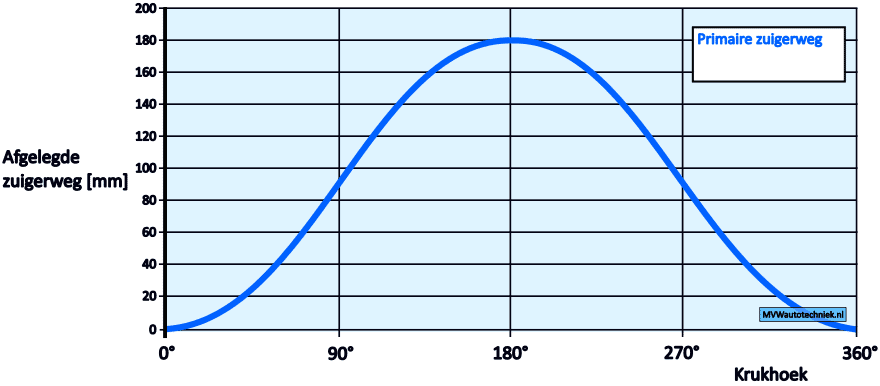
The force in the direction from TDC to BDC and the force from BDC to TDC together cause a vibration that occurs once per crankshaft revolution. That is why this force is also called the primary force. The primary force causes a primary movement.
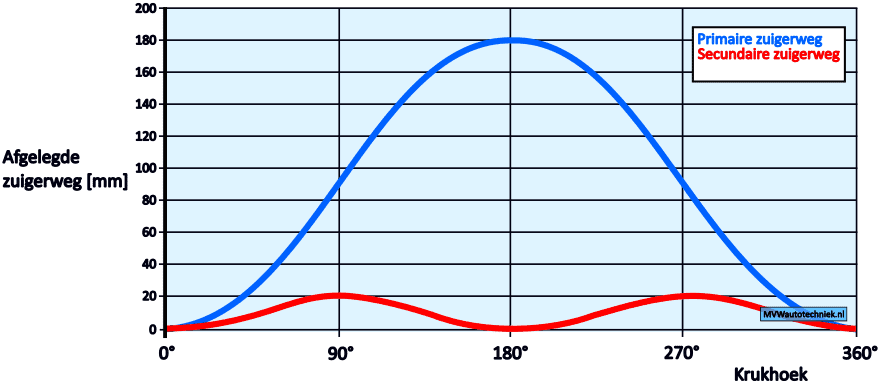
- The primary piston movement is 0 at 0° crankshaft rotation and also 0 at 180°;
- If we look only at the primary piston movement, the piston is halfway through the stroke (and thus also halfway in the cylinder) at 90° crankshaft rotation, namely at 90 mm.
Secondary piston movement:
The lateral movement of the connecting rod creates the secondary piston movement. The larger the ratio between crankpin and connecting rod length, the greater the secondary force and thus the secondary movement.
- At TDC, the secondary movement is 0;
- At 90° crankshaft rotation, the secondary movement is at its maximum;
- The distance the piston covers during the secondary movement is added to the primary movement. This is the actual distance the piston has travelled.
Actual piston movement:
The actual piston movement is formed by the sum of the primary and secondary piston movements. In the graph this can be read as “total”.
- The piston is already halfway along the stroke it makes in the cylinder before the crankshaft has rotated 90 degrees. In the graph we see that the piston has travelled 110 mm at 90 degrees. That is 61% of the total stroke;
- The length of the crankpin, and therefore the crank-connecting rod ratio (often referred to as lambda), determine the secondary and thus the total piston travel.
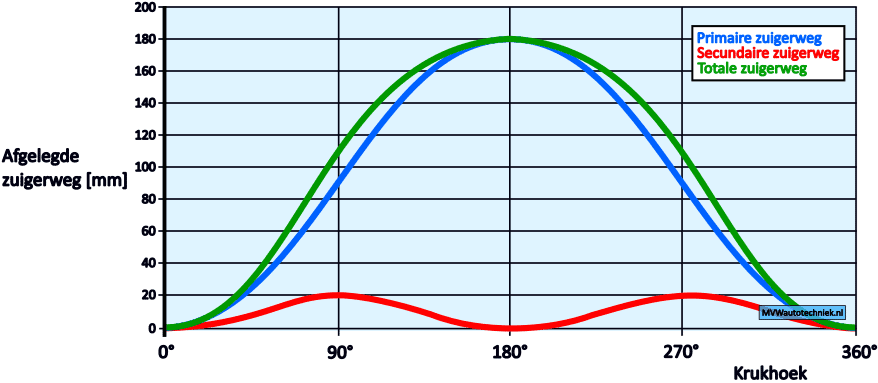
The secondary piston movement amplifies engine vibrations. In an engine with four or fewer cylinders, where the secondary forces are relatively large, balancer shafts are used to reduce engine vibrations.
Piston speed:
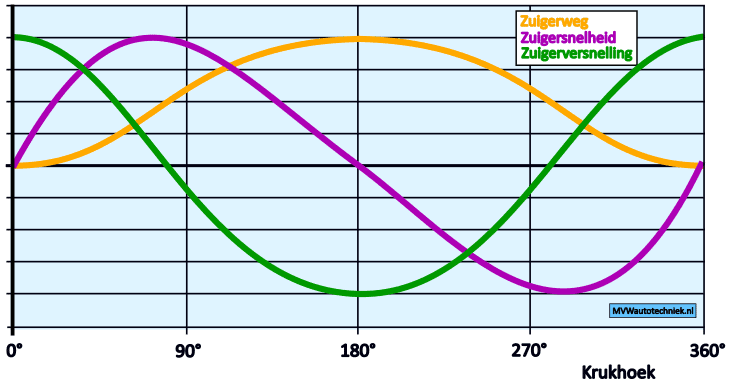
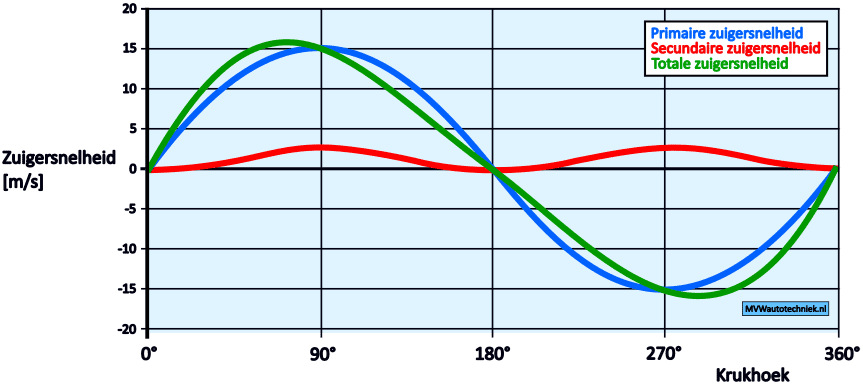
During the power stroke, the piston reverses its direction of movement at BDC and TDC. At BDC and TDC, piston speed is zero. This is because the piston changes direction at these points. As the piston moves from TDC to BDC, piston speed increases. Around 90 degrees of crankshaft rotation, the primary piston speed reaches its maximum value. This is the result of the positive acceleration of the piston during the downward movement. However, as the connecting rod angle becomes larger, the secondary piston speed starts to play a role. The secondary piston speed is related to the tilting of the connecting rod and provides an additional contribution to the total piston speed. Because of this secondary piston speed, the total piston speed reaches its maximum value earlier than it would due to the primary piston speed alone. This typically occurs before the 90-degree crankshaft angle. In the graph below we can see that the total piston speed is already at its maximum at approximately 75°.
Piston acceleration:
The previous section discussed piston speed. The graph shows that the piston speed is 0 at TDC and BDC, and that the speed rises and falls during the downward and upward movement. With piston acceleration we look at the acceleration and deceleration of the piston in the cylinder.
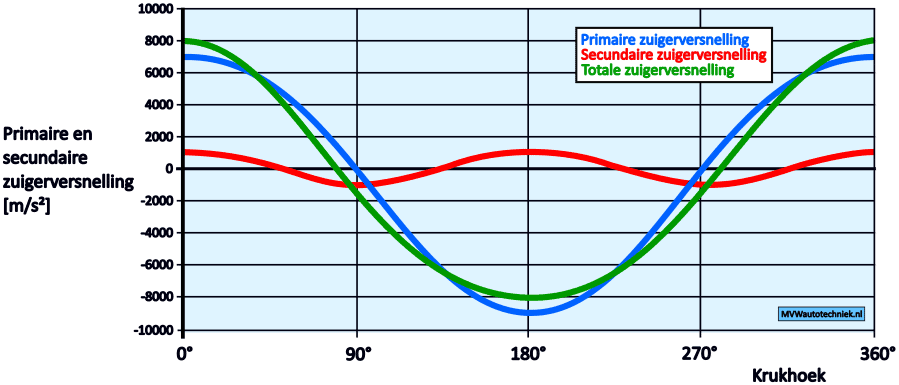
When the crank angle is 0 degrees, the piston is at the top of its stroke, ready to begin its downward movement. Piston acceleration is maximal at this point. This is due to the abrupt change in the direction of motion of the piston, from stationary at the highest point to starting its downward movement. While moving towards BDC, the acceleration decreases. The primary piston acceleration is 0 at 90 degrees of crankshaft rotation. In the previous section we can see that piston speed starts to decrease again at 90 degrees. Between 90 and 180 crank degrees, the piston decelerates until it reaches BDC. In the graph we see this deceleration as negative acceleration.
The secondary piston acceleration again arises from the tilting of the connecting rod. In an engine with an offset (desaxe) connecting rod, the connecting rod is already at a small angle at the moment the piston is at TDC. As a result of the secondary piston acceleration, the total piston acceleration increases during the first crankshaft degrees.
Overview of piston travel, speed and acceleration:
In the previous sections, the primary, secondary and total movements and speeds were discussed for each graph. In this overview we see the totals in a single graph.
- During the downward movement of the piston, the piston travel increases (from 0 to 180°);
- Between the previous stroke and the current stroke, the piston has reversed its direction of movement. Due to the sudden change in direction of movement, piston acceleration is maximal from 0 crankshaft degrees;
- Piston speed gradually increases and is at its maximum before the crankshaft has rotated 90°;
- At 180°, both piston speed and piston acceleration are 0;
- During the upward movement towards TDC, the graphs of piston acceleration and speed are mirrored.