Power steering:
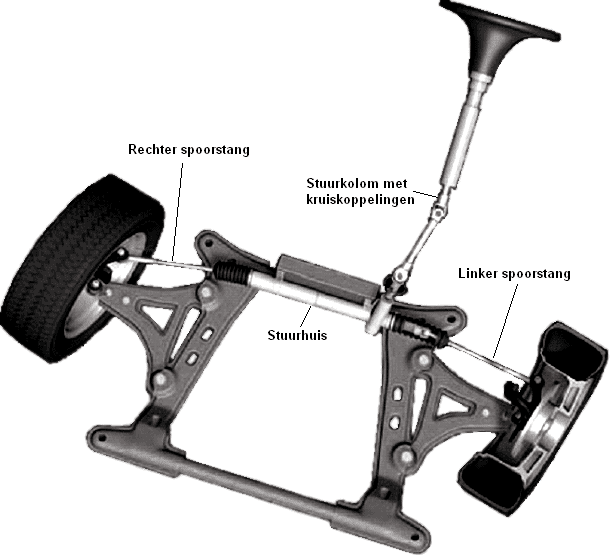
The function of power steering is to allow the driver to turn the wheels with little physical effort. Especially with a heavy car with wide wheels, it is virtually impossible to drive properly without power steering. Parking would be very difficult as well. In the image below, the subframe of a car can be seen with a steering rack of the “direct” type mounted to it. The power assistance takes place inside this steering rack.
The power steering system operates with oil that is pressurized. This oil is pumped through the entire system by the power steering pump. The oil pressure helps reduce the amount of force required for steering movements.
Operation:
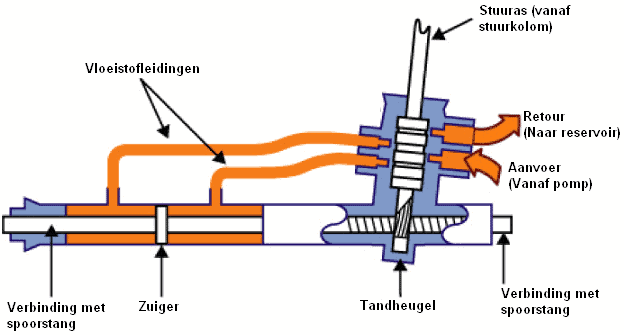
The power steering pump feeds the oil via the supply line to the steering rack. The oil is always present on both sides of the piston in the steering rack. More information about the steering rack can be found on the steering system page.
When turning left, the pressure on the right-hand side of the piston will become higher than on the left-hand side. The piston will move to the left together with the steering movement. The oil on the left side will then flow back to the reservoir via the return line (the space in the left chamber then becomes smaller than that in the right). When turning right again, the oil pressure in the left chamber is increased. The piston moves to the right with the steering movements and the oil in the right chamber is routed back to the reservoir via the return line. With steering movements, the oil pressure in the left or right chamber is increased or decreased. The alternating operation of the oil pressure is controlled internally by small valves.
A common mistake is that when the steering is at full lock (so the steering wheel is turned as far as it will go), people continue to apply force to the blocked steering wheel. What happens then is that the piston is in its maximum position (left or right) and the pump continues to generate maximum pump pressure. In most cases, a scraping or whining noise can be heard from the pump. Therefore, always make sure that the steering wheel is only lightly held against the stop at full lock (preferably just not fully against the stop). Do not apply force, because the wheels will not turn any further anyway.
Power steering pump:
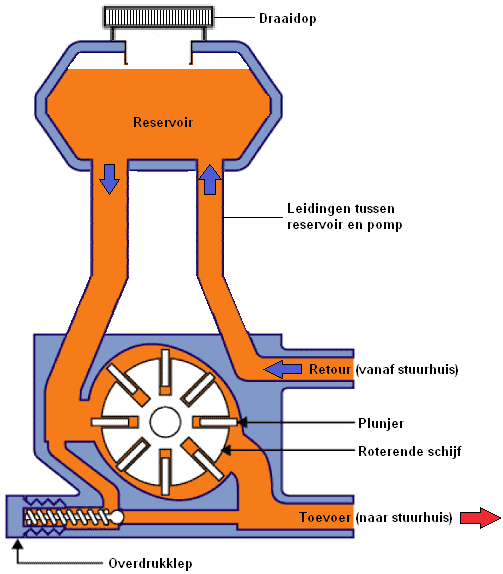
The image alongside shows a power steering pump with its associated components. This pump is also called a servo pump. The pump is driven by the multi-rib belt. The rotating disc in the pump turns (at the same speed as the crankshaft). The plungers move outward due to centrifugal force. The oil in the reservoir is pumped by these plungers into the feed line (visible at the bottom of the image).
When the speed of the crankshaft becomes too high, the pressure relief valve opens. The pump pressure will not exceed approximately 1.5 bar. The oil flowing past the pressure relief valve returns to the section before the pump section. This oil will pass through the pump again. As soon as the engine speed drops, the pressure relief valve closes and the full oil pressure is pumped through the feed line. The oil returning from the steering rack flows back into the reservoir. It is a closed system, so what is pumped out always returns via the return line.
Power steering fluid:
If the power steering fluid level drops below the minimum, there is a risk that the pump will run dry. This can be heard as a humming noise from the pump. The pump will then wear out faster and fail prematurely. The reservoir has markings (min. and max.). Often, a temperature is also indicated at max. (e.g. 20 degrees Celsius). This is because the hydraulic oil in the power steering circuit expands when the temperature rises. At a high temperature, the oil level in the reservoir will be higher than when the oil is cold. This must always be carefully checked.
It is also important that the correct oil is always topped up (according to the factory specification). The oil in the system may be ATF (Automatic Transmission Fluid) or CHF-11s. The latter is a special type of hydraulic oil (green in color). These oils must not be mixed or replaced with other types. Doing so may cause damage to the power steering pump or the steering rack.
More information about the steering rack can be found on the steering system page.
Electronic power steering:
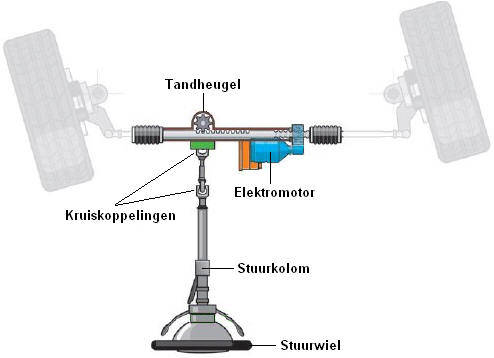
Electronic power steering, also called EPS (Electronic Power Steering), replaces the conventional hydraulic power steering system. Sometimes a combination of electro-hydraulic power steering is used.
With electronic power steering, just like with the hydraulic system, the steering movements are transmitted from the steering wheel and steering column to the rack. The rack moves the tie rods to the left or right. The electric motor amplifies the steering movements.
In order to provide the correct level of assistance, it is important that the steering torque on the rack is measured. Together with the steering angle signal, the electric motor will amplify the steering movements. The electronics of the electric motor can provide varying degrees of assistance. In this way, power steering can be maximized in city traffic so that the steering wheel can be turned with little effort. At higher speeds, the electric motor can reduce the assistance so that the steering feels “heavier” and is therefore more precise to control.