Topics:
- Video of running engine
- Measurement results
- Graphs
- Scatter plot
Video of the running engine:
In the previous stage, the engine was made operational on the MegaSquirt engine management system. Using the TunerStudio program, the MegaSquirt ECU was programmed and properly configured. This paragraph shows a video that was made after the settings were completed. The video is divided into three parts:
- starting and idling;
- idling and showing components such as the modified intake manifold and ignition coil;
- increased engine speed.
Measurement results:
The video shows that the engine starts well, idles smoothly, and the engine speed can be increased to 3000 rpm without any problems. To check whether the engine operates properly on the installed engine management system, it is important to log all sensor values and actuator controls. This provides insight into whether the engine management system functions correctly under different operating conditions. Therefore, it was decided to extend the existing “TunerStudio” program with a software package that enables logging.
The achieved results are listed in this chapter and are presented by means of graphs and scatter plots. These were generated using the log function in TunerStudio. After all adjustments had been made, the engine was run for several minutes. This covered the entire warm-up phase, the engine idled for several minutes, and the engine speed was increased to 3000 rpm for several minutes.
Graphs:
Adjusting with TunerStudio is done with live data; the gauges on the dashboard show the current value. There is also an option to log the data. A log contains information from the sensors and actuators that has been stored over a certain period of time. The measurement results can therefore be reviewed afterwards. This provides insight into whether the data is being processed correctly and whether the engine is functioning properly.
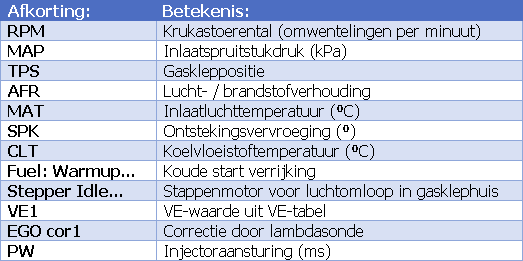
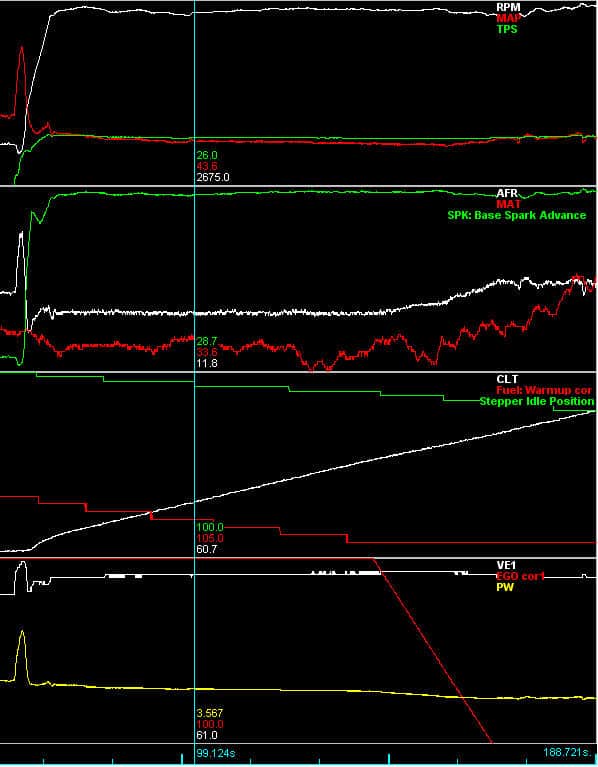
The images below show the measurement results recorded during the test run. The abbreviations are explained in the table.
The measurement results are divided over four screens that share the same time axis. The vertical blue line serves as a cursor that moves from left to right across the screen. In the top screen, the crankshaft speed, the vacuum in the intake manifold and the throttle position can be seen. The engine speed increases from idle (400 rpm) to 2675 rpm. The time between opening the throttle and the increase in engine speed is visible as the negative dip in the RPM line. At that moment, the vacuum decreases (peak) and the value of the throttle position sensor increases. The value of the throttle position sensor is used to determine the acceleration enrichment; acceleration briefly requires a richer mixture.
In the second screen the AFR is visible. At the point where the cursor is located, the AFR is 11.8, so the mixture is rich. The intake air temperature initially fluctuates around 20⁰C, but later rises to 33.6⁰C. The green line indicates the ignition advance; during the constant engine speed of approximately 2500 – 2675 rpm, the ignition is advanced by around 28.7 to 30.0 degrees.
The third screen shows the increasing coolant temperature. As a result, the cold-start enrichment decreases and the stepper motor closes further.
The bottom screen shows the volumetric efficiency (filling ratio), which is 61% at the cursor position. The lambda sensor correction and injector actuation are also shown. At the cursor position the injector is actuated for 3.567 milliseconds. This is the actual injection time.
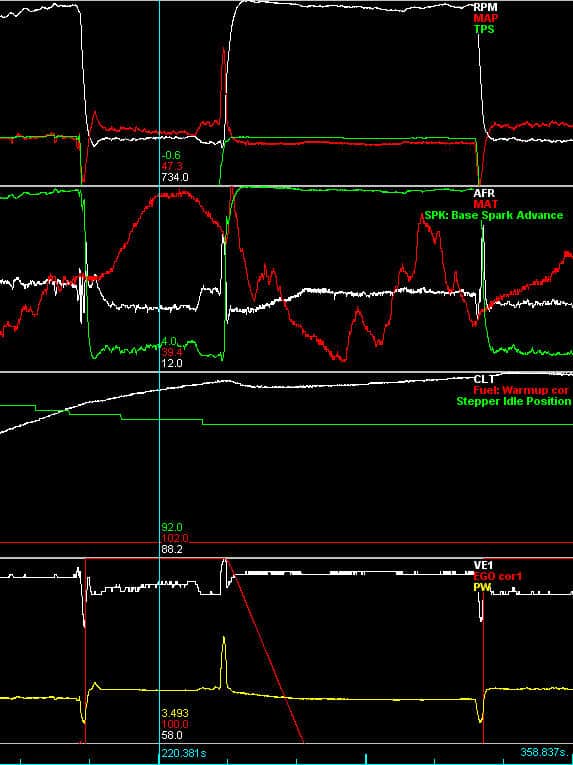
Below are the measurement results that were recorded several minutes later.
The next image shows the measurement results for the situation in which the engine speed drops from 2675 rpm to the idle speed of 734 rpm and then rises again. When the engine speed drops, the acceleration enrichment stops; the TPS registers that the throttle has returned to its initial position. Closing the throttle does, however, cause a high vacuum in the intake manifold for a short time. This can be seen from the negative dip in the MAP value. When the throttle is opened again, the vacuum disappears; the MAP value then rises for a few milliseconds.
The ignition advance during idling has dropped from 28.7 to about 4 degrees BTDC.
When a temperature of 90⁰C is reached, the stepper motor has reached its maximum position; the idle control valve is then fully closed.
The decreasing and increasing engine speed naturally also affects the injection time; during deceleration the injection time drops to 1.3 ms (not visible in the graph). During the rise in engine speed, the actuation time is briefly increased to 7 ms. At a constant, elevated engine speed, the injection time then drops again to about 3.5 ms.
Scatter plot:
The entire cycle is shown in the image in a so‑called “scatterplot”, in Dutch translated as “spreidingsdiagram”. Two scatter plots are displayed next to each other, with the total progression shown underneath in graph form.
When any point in the graph is clicked, a circle is displayed in both diagrams. Clicking on different areas in the graph shows a different location in the scatter plots.
In this scatter plot, the left diagram shows the MAP value in relation to the crankshaft speed. The coloured bar to the right of the diagram indicates the AFR.
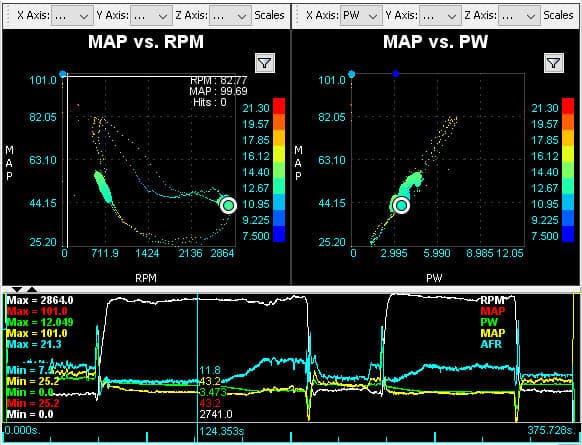
In the left diagram the AFR is approximately 12.67. This means that the mixture is rich at that moment. Given the elevated engine speed at a low coolant temperature (see the progression of the coolant temperature in figure 46), this can be explained. Furthermore, it can be seen that the AFR in the top left lies between 17.85 and 19.57; this is during deceleration when no fuel is injected and the mixture is lean.
The right diagram in figure 48 shows the MAP value in relation to the fuel injection. The operating range can be seen here.
With the positive outcome of the measurement results, the project has been successfully completed.