Roll center:
Every vehicle has a roll center. The design of the control arms and springs determines the height of the roll center (the roll axis), which is responsible for the body leaning or rolling. In modern cars, the roll axis is usually located slightly below the center of the wheels, almost parallel to the road surface and as close as possible to the vehicle’s center of gravity. The distance between the center of gravity and the roll axis must be kept as small as possible, in order to minimize the “roll effect”. More about this is explained in the next chapter on this page.
To limit body roll, an anti-roll bar, suitable shock absorbers and springs with the correct spring characteristic are used.
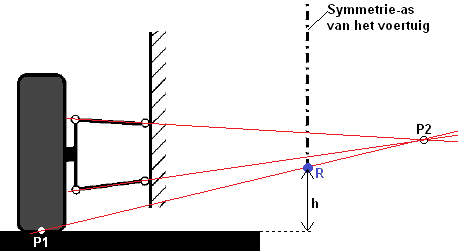
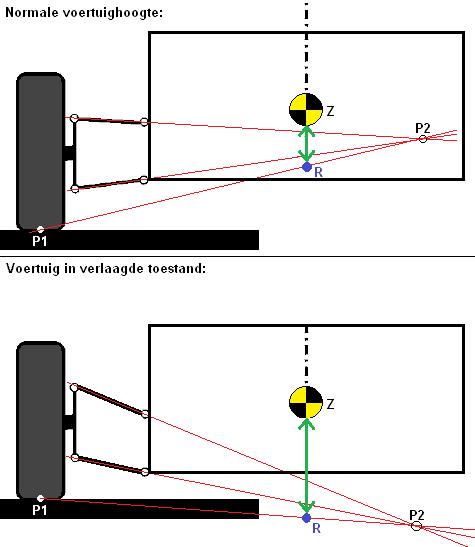
The roll center of a vehicle is determined from points P1 and P2 (see image on the right), which are calculated by (imaginarily) extending the springs / control arms (see images). By extending both control arms, point P2 is found (where the lines intersect). The line from point P1 (the center of the tire–road contact patch) to the previously found point P2 can then be drawn. The roll center R now lies on the symmetry axis of the vehicle (the exact center).
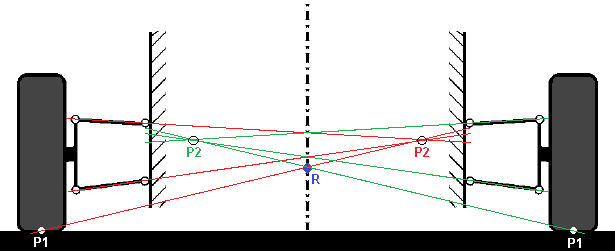
To clarify this illustration further, the right wheel with the corresponding lines is also drawn in the image on the right. Here you can see that the roll center lies at the same point, because the vehicle is completely symmetrical. This means that both the left and right sides of the vehicle are identical.
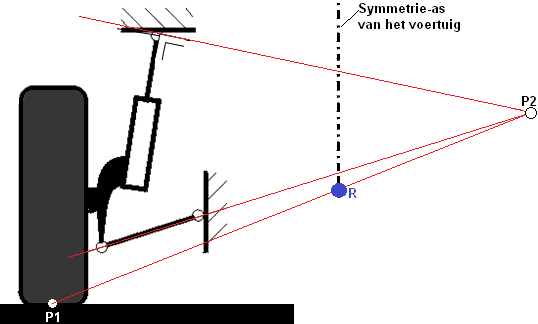
This illustration shows the situation with a MacPherson strut. The upper line must be perpendicular to the shock absorber. The line below it is drawn through the control arm up to the point where it intersects the upper line. This is the common point P2. Then the line P1 is drawn from the center of the tire to P2. The roll axis R lies on the line from P1 to P2, exactly on the symmetry axis of the vehicle.
Influence of lowering on the roll center:
Lowering a car has negative effects on the roll center. When the roll center shifts too far and the distance between the vehicle’s center of gravity and the roll axis becomes too large, the vehicle will roll more around its axis. Various measures must then be taken to prevent the driving characteristics from deteriorating, such as:
- Shock absorbers with a higher damping factor
- Springs with a stiffer spring characteristic
- Anti-roll bar (possibly a stiffer version than the original)
On the images on the right two different situations can be seen: the upper one of a non-lowered car and the lower one of a lowered car. The center of gravity (Z), indicated by the yellow-black marking, moves downwards proportionally with the vehicle. The distance between the two vehicles (indicated by the green arrow) has increased considerably.
In the lowered state, the roll center lies in the road surface.
For track cars this is done deliberately. The roll center then lies 2 to 3 cm in the road surface. The entire suspension is adapted to this (springs, shock absorbers and anti-roll bar). If this is not done (by only fitting lowering springs), the greater distance (the green arrows) will cause the center of gravity (Z) to tilt around the roll axis (R). This creates a kind of force times lever situation.
There are conversion options in which, by using larger ball joints, the control arms are positioned more horizontally on the steering knuckle. The roll center then moves closer again to the center of gravity. In this latter case, the center of gravity has been lowered by lowering the car, without having negative effects on the roll center. In this way, the driving characteristics will be greatly improved.
More information about wheel angles and adjustments can be found on the wheel geometry page.