Topics:
Anti-roll bar:
An anti-roll bar is a solid steel bar in a U-shape that is mounted at the ends to the struts and in the middle to the bodywork. The purpose of the anti-roll bar is to counteract the tendency of the car to roll when cornering. It improves cornering stability by making the spring struts work together in the suspension. The anti-roll bar provides roll stiffness for the front or rear axle.
When taking corners, the springs on the inside of the vehicle will extend and those on the outside will compress. In a left-hand corner, the springs on the left (inside of the bend) will extend and the springs on the right (outside of the bend) will compress. The car now makes a rolling motion. The amount of roll depends on the car’s roll center. The position of the center of gravity and the roll center must be as optimal as possible; they should be as close together as possible. The further apart the center of gravity and the roll center are, the more the vehicle will roll.
Because one side compresses and the other side extends, the anti-roll bar will twist. The bar tries to keep both sides equal and will therefore pull the body down on the side that extends (the inside). Because this side is pulled down, it will also compress partly. This achieves the goal of the anti-roll bar: the movement of one wheel has been transferred to the other wheel. The car now sits flatter and more stable in the corner, because it leans much less. As a result, cornering stability is greatly improved.
The anti-roll bar is attached to the body with rubber mounts. At both ends of the anti-roll bar there are drop links on each side that attach the bar to the strut or the control arm. When there is play in the rubbers or in the ball joints of the drop links, a creaking or knocking noise will be audible when driving on a bumpy road.
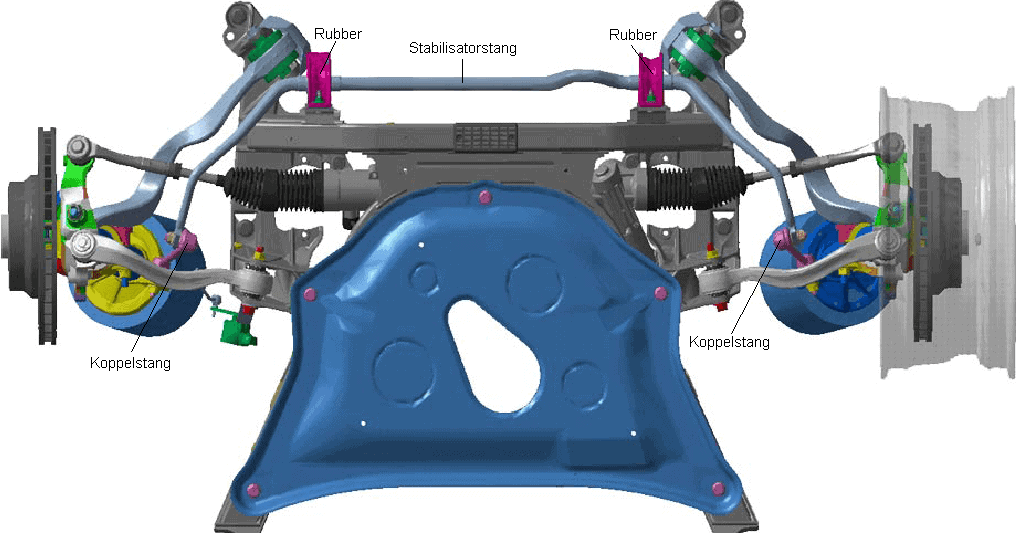
In the image above, the complete front axle of a car is shown. The anti-roll bar with its rubbers and brackets is clearly visible. The purple brackets with rubbers are attached to the subframe and the two purple drop links are attached to the control arms. The anti-roll bar therefore pulls and pushes against these control arms.
The anti-roll bar also has a major influence on steering behavior:
- Front axle stiffer in roll: more understeer (thus less oversteer)
- Rear axle stiffer in roll: more oversteer (thus less understeer)
It is therefore important that when increasing roll stiffness, i.e. when adding or modifying an anti-roll bar, this is done in the same way on both the front and rear axles. When only the front axle is made stiffer in roll, the car will understeer more easily. That means the car will go straight ahead more readily in a corner.
Strut brace:
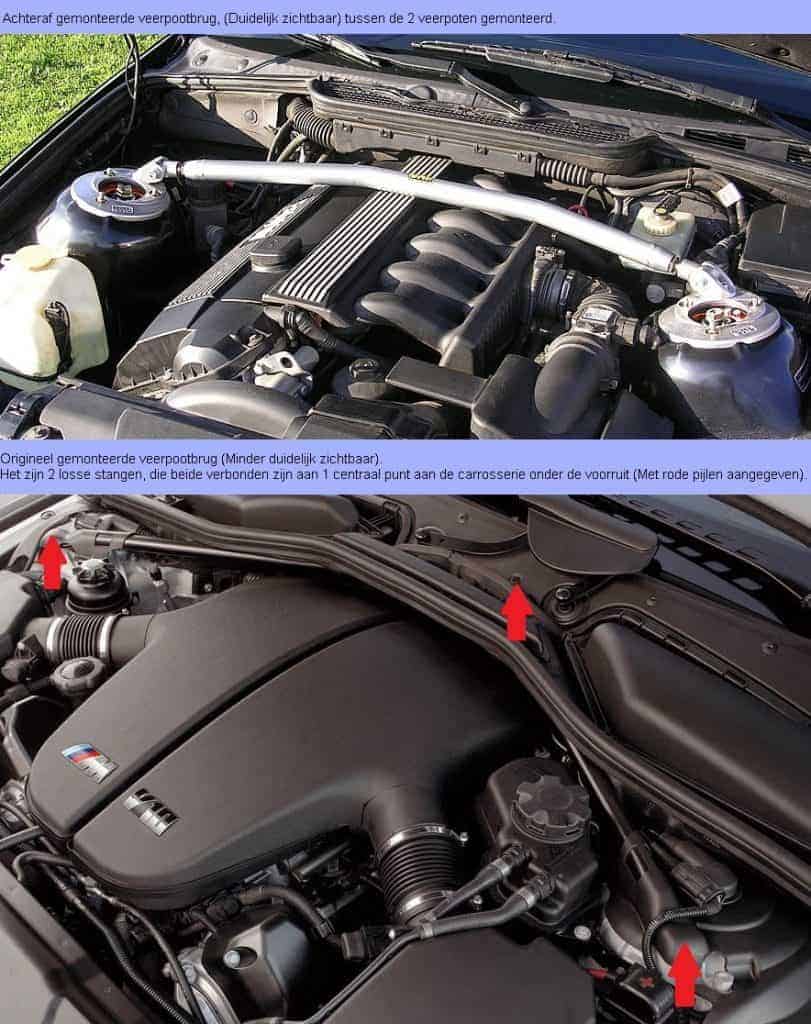
The functions of the anti-roll bar and the strut brace are often confused. It is often thought that they have the same function, but this is not the case. An anti-roll bar’s function is to improve cornering stability by transmitting the movements of the two wheels to each other. A strut brace is intended to counteract torsion in the body and chassis. A strut brace is a bar that is mounted at the top between the ends of the two struts under the bonnet. Some cars also have a brace under the front suspension.
When cornering, the body will also twist slightly. The strut brace counteracts this torsion because the body becomes stiffer, and this will be noticeable in sporty driving. You can drive sportier and faster through corners. That is why you often see sports cars where the owner has fitted a strut brace. On most sporty cars produced today, a strut brace is already fitted as standard.
Related pages: