Introduction:
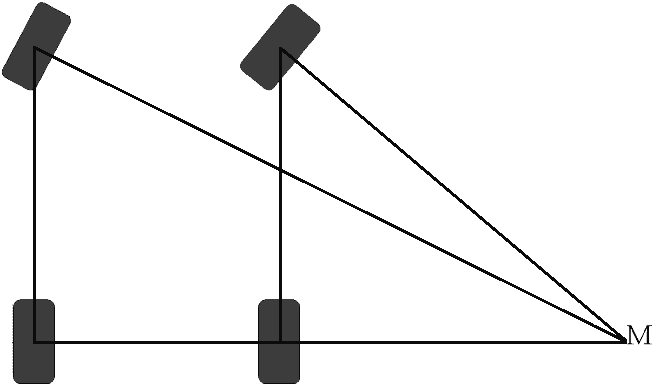
The front wheels do not steer at the same angle in a corner. The inner wheel will always take a “sharper” turn than the outer wheel. The image shows why that is.
The image shows that the lines from the front wheels meet at angle M. Angle M is the common pivot point of both front wheels. If the wheels were to turn at the same angle (the wheels would then both be in exactly the same position), the lines from the wheels would also run parallel to each other into infinity. They would never find the common pivot point M. Therefore, the steering characteristics in this situation would be very poor. This whole principle is called “toe-out on turns”. All modern cars are designed with this characteristic.
On slippery surfaces, e.g. the floor in a parking garage, you can hear squealing of the tyres when steering in. This is caused by this principle. The inner wheel, which turns at a sharper angle than the outer one, will experience some form of slip. This is called a steering error. More information about the steering error (and a graph) can be found on the page stuurfout.
This page explains how, using a number of data points, the steered angles (in degrees) of both front wheels can be calculated.
Calculating the steered angles:
To calculate the steered angles, the following data from the vehicle are required:
- Track width
- Wheelbase
- Turning-circle diameter
- Kingpin distance (on this page we assume the kingpin distance equals the track width)
- Tyre size (depending on the calculation. On this page we calculate with the tyre size, but the calculation can also be done up to the bumper corners. However, that would introduce more angles).
| Track width = 1600mm | Wheelbase = 3200mm |
| Turning-circle diameter = 13,225m | Kingpin distance = Track width = 1600mm |
| Tyre size = 225 | L and L’ = unknown |
Explanation of the symbols:
α = Alpha
β = Beta
γ = Gamma
These letters are from the Greek alphabet and are often used for angle calculations.
L = the length
L’ = L with an “accent” added, which is widely used in mathematics. It could just as well have been L2. A 3rd L would then have received two accents: L” .
The same applies to R”.
The angles Alpha, Beta and Gamma are located at point M.
Angle Alpha + Gamma = angle Beta.
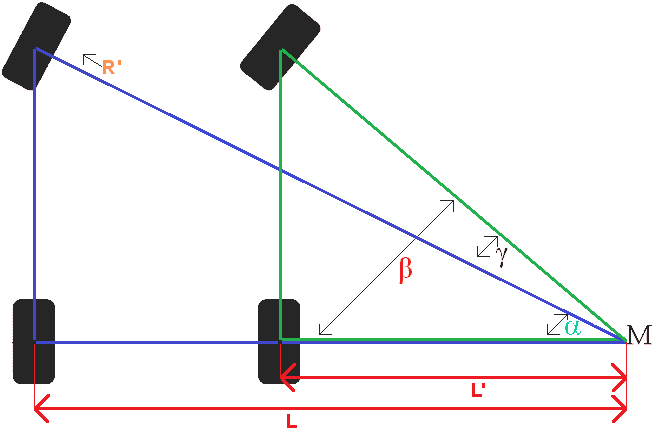
The total turning circle is 13.225 metres. R is the radius, so that is half the turning circle (6612.5). In the image, R’ is given. This R’ is not a fixed value. It must be calculated by subtracting half the tyre width. Another way is to subtract the kingpin distance, but on this page we assume: Track width = kingpin distance. This leads to the simple calculation:
R = 6612.5 mm
R’ = R – half tyre width
R’ = 6612.5 – (225 : 2)
R’ = 6612.5 – 112.5
R’ = 6500 mm
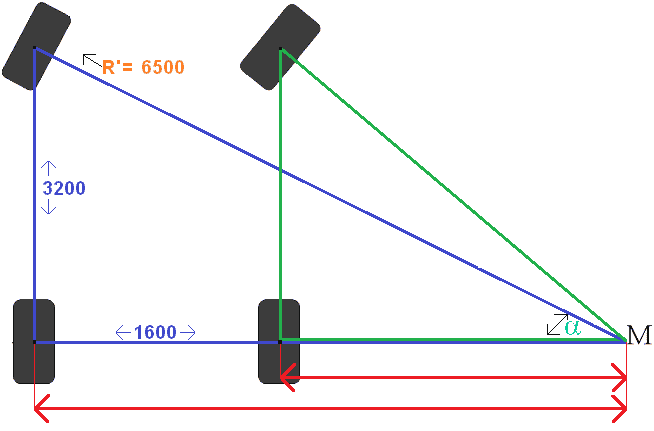
We fill R’ into the image. Next, we calculate the angle sin α (sine Alpha) using the Sine rule. Then we calculate the remaining angles using the Tangent and Pythagoras’ Theorem.
Angle calculation with the Sine:
Sin α = Opposite side : Hypotenuse
Sin α = Wb : R’
Sin α = 3200 : 6500
Sin α = 0.492
Inv Sin α = 29.5°
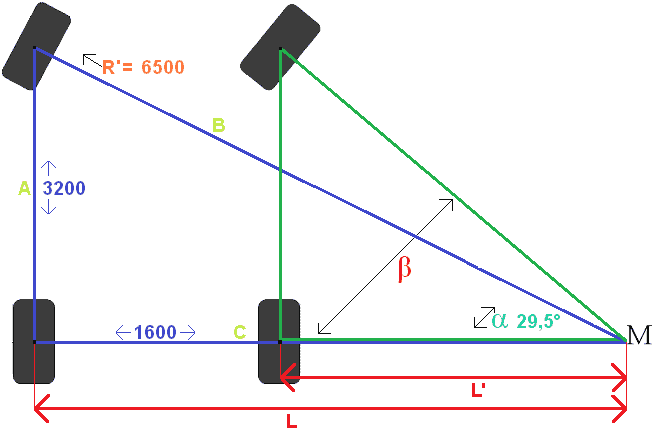
Explanation of the calculation:
We want to calculate Sin α. The sine is the opposite side divided by the hypotenuse (memory aid: SIN = SOH).
Wb = wheelbase = 3200mm. R’ was calculated earlier = 6500mm.
We then divide these by each other; then we have Sin α = 0.492. To convert this number into an angle, press the sin-1 button on the calculator (usually press the Shift key first and then the Sin key) followed by 0.492, or the ANS button. The angle of 29.5 degrees will now appear.
Sin α is now known. We actually want to calculate tan β, but for that we need the length L’. This must be calculated first. We will use the result of the L’ calculation later to calculate Tan β.
L’ = L – Track width.
We calculate L with Pythagoras’ theorem. The 2 sides of the triangle are known (6500 and 3200). The other side of 1600 is the track width that runs from tyre to tyre, so that one does not count. We are going to calculate the bottom side, which runs from the left rear tyre to the common point M. The calculation therefore concerns the complete blue triangle.
Pythagoras’ theorem looks as follows:
A^2 + B^2 = C^2. (The symbol ^ stands for “to the power of”. So it reads A squared + B squared = C squared. We phrase it slightly differently below.
We call the length 3200 A, 6500 we call B and the unknown bottom side we call C:
C^2 = 6500^2 – 3200^2
C^2 = 42250000 – 10240000
C^2 = 32010000^2
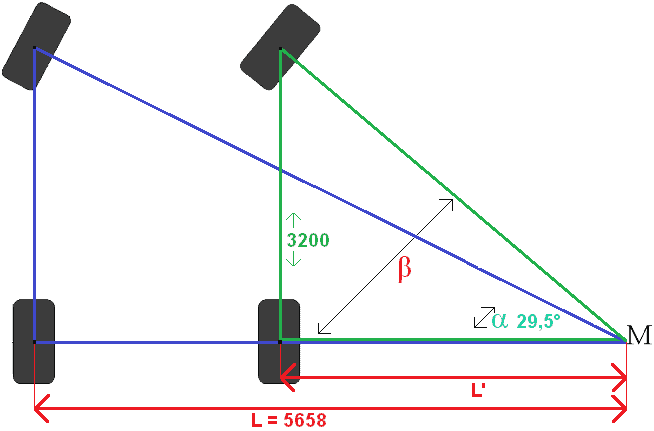
To eliminate the square, we take the root of the number.
C^2 = √32010000
C = 5658mm.
Side C is in fact length L.
Now L’ can be calculated. The full length L and the track width are known, so those two can easily be subtracted from each other:
L’ = L – Track width
L’ = 5658 – 1600
L’ = 4058mm
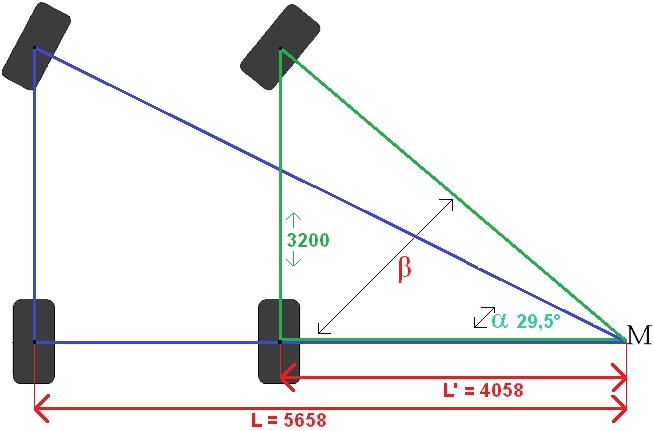
Now Wb and L’ are known. Two of the three sides of the triangle are known, so the third side can be calculated using the Tangent:
Angle calculation with the Tangent:
Tan β = Opposite side : Adjacent side
Tan β = Wb : L’
Tan β = 3200 : 4058
Tan β = 0.789
Inv Tan β = 38.3°
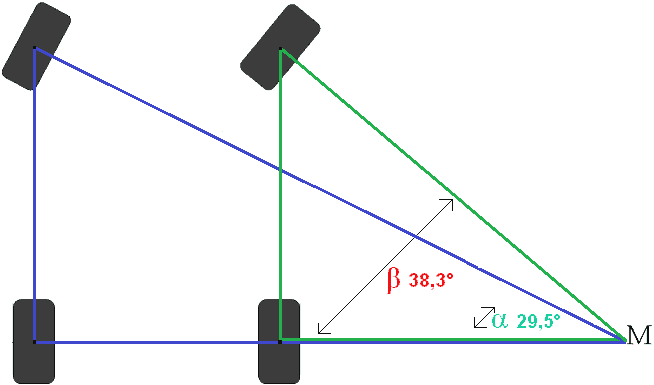
Explanation of the calculation:
We want to calculate Tan β. The tangent is the opposite side divided by the adjacent side (memory aid: TAN = TOA).
Wb = wheelbase = 3200mm. L’ was calculated earlier = 4058mm.
We then divide these by each other; then we have Tan β = 0.789. To convert this number into an angle, press the tan-1 button on the calculator (usually press the Shift key first and then the Tan key) followed by 0.789, or the ANS button. The angle of 38.3 degrees will now appear.
The steered angles of both front wheels have now been calculated. The left front wheel is at an angle of 29.5° and the right front wheel at an angle of 38.3°. This means that the steered angle differs between the two wheels by 8.8°. In a left-hand turn, the same steered angle will occur with the same steering lock.
The page wheel alignment describes several wheel alignments.