Topics:
Operation of torque converter:
The torque converter is mounted between the engine and the automatic transmission and consists of 3 basic components: the pump impeller, the stator and the turbine wheel. In a torque converter, the force exerted by the engine is transferred by means of a fluid flow to the driven wheels. The pump impeller starts to rotate. Due to the centrifugal force, the fluid is flung outward. The fluid flows along the curved blades of the turbine wheel. The aim is that when the pressure increases, that is, when more oil is pumped into the blades of the turbine wheel, the turbine starts to rotate with it.
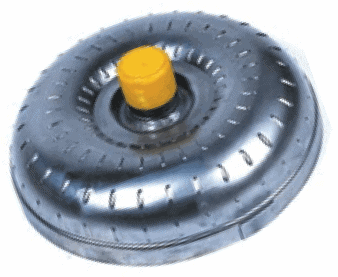
When the engine speed is low, the centrifugal force of the fluid will still be too low to make the turbine wheel rotate. As the engine speed increases, the centrifugal force will become so great that the turbine wheel is taken along and the vehicle will start to move. The speed of the turbine wheel will increase until it almost reaches the speed of the engine. The pump speed and turbine speed will never become completely equal during normal driving, because there are always certain losses, for example when the oil collides with the sides of the blades. There is therefore always a certain amount of slip. That is also the reason why cars with automatic transmissions always use slightly more fuel than cars with a manual transmission.
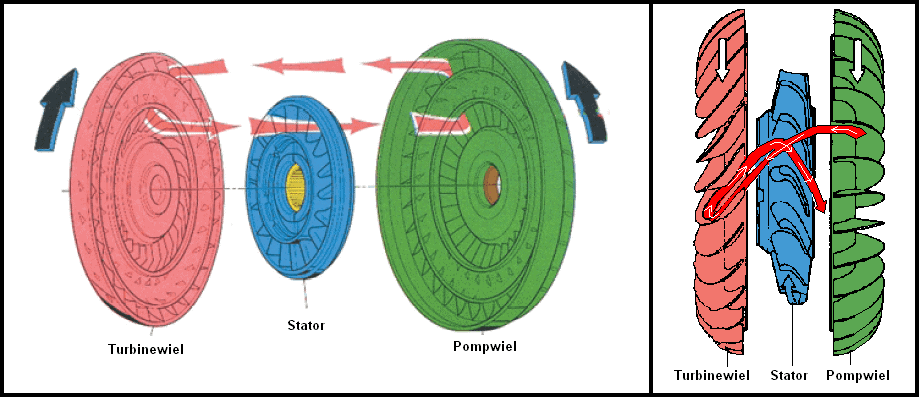
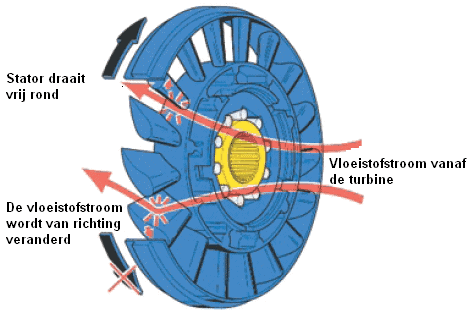
The stator is an annular component that rotates along with the speed of the turbine. The stator ensures that the turbine is driven more powerfully. The stator has a freewheel function and can only rotate in one direction. The oil that flows back from the turbine can thus push against the stator, creating slightly more pressure in the turbine (see illustration).