History of the diesel engine:
The diesel engine is named after its inventor Rudolf Diesel (1858-1913). The first diesel engine based on Diesel’s theory became reality on 17 February 1894. This engine worked on the principle of self-ignition and ran for 1 minute at 88 rpm. Robert Bosch developed the high-pressure injection pump that enabled the diesel engine to begin its worldwide conquest.
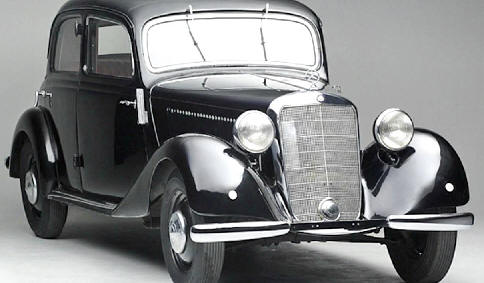
The first passenger car with a diesel engine was the Mercedes-Benz 170D from 1935.
Operation:
A diesel engine receives air in the cylinders, not a mixture as is often the case with petrol engines. In petrol engines the fuel is often already mixed with the air (the mixture). In a diesel engine the air is sometimes drawn in by the engine itself (without turbo), but usually supplied under pressure by a turbo. This is called supercharging. Due to the supercharging, a larger amount of air enters, which can be ignited with extra fuel. You can find more information about supercharging on the turbo page. The diesel engine is supplied with as much air as possible, which is not controlled by quantity as it is in a petrol engine. The unlimited air supply is called an “air surplus”.
In the diesel engine the fuel is not ignited with the help of a component (as the spark plug ignites the petrol fuel in a petrol engine). In a diesel engine, combustion is initiated by injecting the diesel fuel. Because of this, the diesel engine is called a “compression-ignition engine”. The high-pressure fuel pump provides the required fuel pressure.
A lot of heat is required for this combustion. This heat is created by the high compression pressure that the piston produces during compression. By compressing the air (which is put under very high pressure) a lot of heat is generated. This heat is necessary for combustion.
The injector injects a certain amount of diesel fuel just before the piston reaches TDC. This usually happens in several steps, with pre-, main- and post-injection. Because the diesel fuel mixes with the hot air (due to the high end-of-compression pressure) the fuel ignites by itself. This is called the power stroke (more about the four-stroke process later).
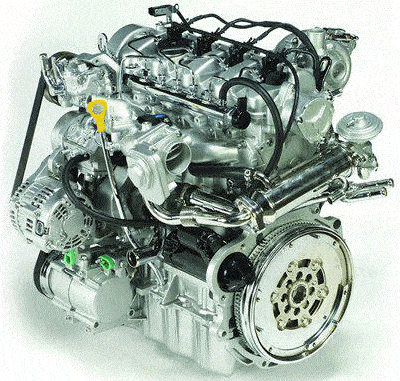
The diesel engine therefore needs heat to start combustion. This heat (at least 250 degrees) is not yet present when the engine is started. The end-of-compression pressure often does not yet provide the correct temperature in the combustion chamber. To solve this, glow plugs are fitted in the cylinder head. These glow plugs become active when the engine is started and ensure that the air in the combustion chamber has the right temperature to ignite the diesel fuel.
Advantages & disadvantages of the diesel engine
- Advantages of a diesel engine compared with a petrol engine:
Due to the higher compression ratio and the course of the combustion, a diesel engine is more economical than a petrol engine. A diesel engine generally also has a longer service life (depending on how it is used). - Disadvantages of a diesel engine compared with a petrol engine:
A diesel engine is noisier, has a lower power output compared with a petrol engine with the same cylinder capacity (without the use of a turbo and intercooler) and it is a more expensive, more heavily built engine. Preheating the engine is no longer really a disadvantage nowadays, because a direct-injection diesel engine can start perfectly well without preheating. Even at temperatures around freezing it will still start normally after cranking a little longer.
Nowadays diesel engines are becoming ever quieter, making it increasingly difficult to distinguish between petrol and diesel engines.
Working cycle of the four-stroke diesel engine:
A working cycle of a diesel engine consists of four strokes: the intake stroke, the compression stroke, the power stroke and the exhaust stroke. During these strokes the piston has moved down and up twice. As a result, the crankshaft has turned twice.
During each stroke a lot happens: air is drawn in, fuel is injected, the air and fuel are burned and the remaining gases are expelled from the cylinder. Below is a description of exactly what happens in each stroke:
- Intake stroke:
The intake valve is open, the exhaust valve is closed. The piston moves from TDC to BDC.
– Without turbo: Due to the vacuum that is created, air is drawn in.
– With turbo: The intake air is supplied from the turbo into the cylinder space under pressure.There is no control valve in the intake tract, such as the throttle valve of a petrol engine. In a diesel engine, the amount of air that is drawn in is therefore not controllable. The throttle valve that is in the intake system (the throttle plate) only serves to shut the engine down. By closing this valve and thus stopping the air supply, the engine will shut off smoothly.
Compression stroke:
The intake and exhaust valves are closed. The piston moves from BDC to TDC. The air is compressed. As a result, the temperature of the air rises and, depending on the compression ratio, can reach a temperature of about 550 degrees. In a petrol engine this temperature is about 400 degrees. During a cold start, the engine is first warmed up by the glow plugs to reach the temperature at which the mixture can ignite.Power stroke:
The intake and exhaust valves are closed and the piston has compressed the air under very high pressure. A few degrees before TDC, fuel is injected by the injector, which ignites due to the high end-of-compression pressure. Due to the pressure resulting from the combustion, the piston is pushed from TDC to BDC.Exhaust stroke:
The intake valve is closed, the exhaust valve open. The piston moves from BDC to TDC and drives the exhaust gas out. The thermodynamic cycle is described on the Seiliger-process page.
Direct & indirect injection:
An engine can be equipped with direct injection or with indirect injection. The differences between the two systems are described below.
Direct injection:
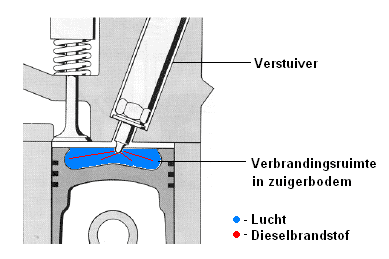
The injection pressure with direct injection is higher than with indirect injection. At the end of the compression stroke the fuel is injected directly into the cylinder (or into the specially shaped piston crown). The mixing therefore takes place in the cylinder and not in the swirl chamber as with indirect injection. To improve mixture formation, the intake air is made to swirl. The swirl is created by the shape of the intake manifold and the shape of the piston crown.
Compared with a diesel engine with indirect injection, a diesel engine with direct injection has the advantage that it requires less wall surface of the combustion chamber. This means that a direct-injection diesel engine will have less loss of compression and combustion heat, resulting in higher efficiency and cleaner exhaust gases.
Indirect injection:
Indirect injection was used most in older diesel engines. Nowadays you hardly come across it anymore.
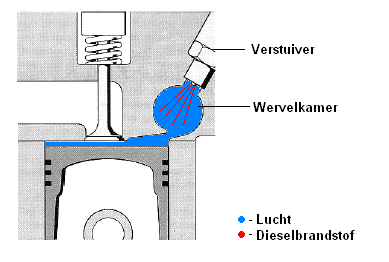
In an engine with indirect injection, the fuel is not injected above the piston, but injected, mixed and evaporated in the swirl chamber. The fuel is injected into the swirling air of the swirl chamber during the compression stroke. In this way a good mixture of fuel and air is created. In this case the piston crown is flat (sometimes still with recesses for the valves).
Low- & high-pressure section:
The fuel supply of a diesel engine is divided into 2 sections: the low-pressure section and the high-pressure section.
The low-pressure section consists of the following components:
- Fuel tank
- Lift pump (mounted in the fuel tank, or integrated with the high-pressure pump)
- Fuel filter (mounted under the car or under the bonnet, removes contaminated particles and moisture from the diesel fuel)
- Low-pressure fuel lines (via these lines the fuel is supplied from the tank to the high-pressure pump)
- Fuel return line (this carries the return and leak fuel from the injectors, high-pressure pump and filter back to the fuel tank). This return/leak fuel is necessary for cooling and lubricating the respective components. The heat is thus carried off to the tank.
The high-pressure section consists of the following components:
- High-pressure fuel lines (via these lines the fuel is supplied from the high-pressure pump to the injectors. The lines must all be equally long and equally thick in order to prevent pressure differences)
- High-pressure pump (the fuel pumped from the lift pump to the high-pressure pump is from here pumped through the high-pressure fuel lines to the injectors)
- Injector (injects the fuel into the cylinder when the opening pressure is reached)
Injection process:
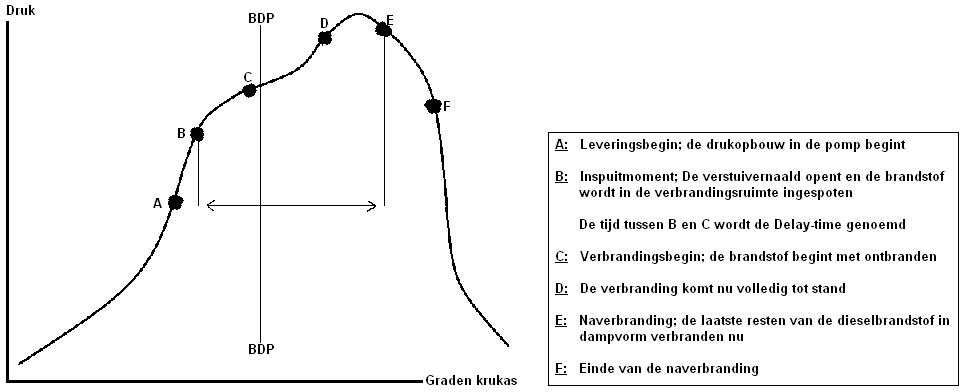
The time between the injection of the fuel and the actual combustion is called the delay time. The small fuel droplets that are injected by the injector must change into a gaseous state. This transition is possible due to the high temperature in the combustion chamber (which is reached by the end-of-compression pressure or by the glow plug during starting). This time must be as short as possible, because otherwise it will affect the combustion. That also means that the engine will run worse and that less power will be available.
The complete injection process is shown in the image below.
Diesel knock:
Between the start of injection (see A in the image above) and the start of combustion (C) there are a few milliseconds. The very small fuel droplets that are injected by the injector (the fuel mist) must first be brought up to temperature in order to change into vapour form. The outer side of the fuel droplet is the first to change into a gaseous state and will then burn gradually. The remaining parts of the droplet then ignite spontaneously and cause the recognisable engine noise: diesel knock. This is uncontrolled combustion and can occur at the wrong moment.
The following issues can cause diesel knock:
- Defective injectors (after-dripping or poor atomisation with droplets that are too large)
- Defective injection pump (delivery valves or plungers defective)
- Fuel (water present, cetane number too low, air in the fuel)
- Engine (end-of-compression pressure too low, glow plugs not working)
- Incorrect timing of the fuel injection pump drive