Direct and indirect injection in petrol engines:
Direct injection:
With direct injection (DI), the petrol is injected directly into the combustion chamber instead of into the intake. With this technique, the petrol can be injected after the compression stroke has already started. This can achieve better combustion.
Indirect injection:
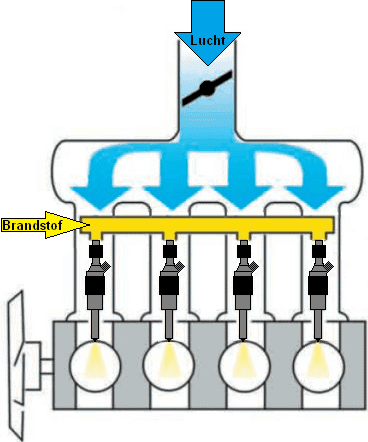
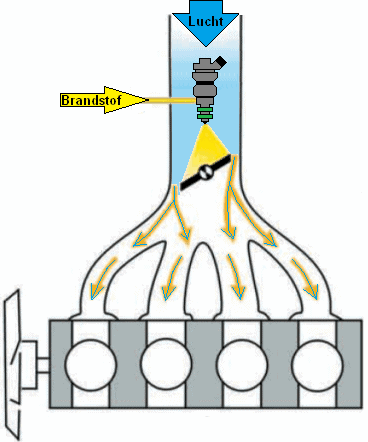
With indirect injection (IDI), the petrol is injected into the intake and drawn into the engine together with the air. In this case, a single injector can be used for all cylinders, or each cylinder can be provided with its own injector. In the latter case, the engine power and emission reduction potential increase, because fuel injection can be optimally adjusted for each cylinder.
Direct and indirect injection in diesel engines:
Direct injection:
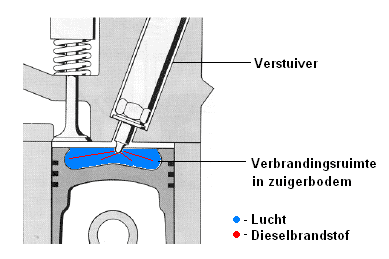
The injection pressure with direct injection is higher than with indirect injection. The fuel is injected directly into the cylinder (or the piston crown shaped for this purpose) at the end of the compression stroke. Mixing therefore takes place in the cylinder itself and not in the swirl chamber as with indirect injection. To improve mixture formation, the intake air is put into a swirling motion. This swirl is created by the design of the intake manifold and the shape of the piston crown.
A diesel engine with direct injection has, compared to a diesel engine with indirect injection, the advantage of having less wall surface area of the combustion chamber. As a result, a directly injected diesel engine will lose less compression and combustion heat and therefore achieve higher efficiency and cleaner exhaust gases.
Indirect injection:
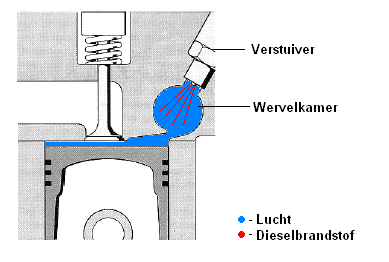
Indirect injection was used most often in older diesel engines. Nowadays you hardly encounter it anymore. The fuel is injected, mixed and evaporated in the swirl chamber and not in the cylinder itself as with directly injected diesel engines. The fuel is injected into the swirling air in the swirl chamber during the compression stroke. In this way, good mixing of fuel and air is achieved.
Related pages: