Introduction:
An electric motor is used to drive a hybrid or fully electric vehicle. The electric motor converts electrical energy (from the battery or range extender) into motion to drive the wheels. In addition, when decelerating on the motor, the electric motor can convert kinetic energy back into electrical energy: regenerative braking. In that case, the electric motor functions as a generator. Because of these two functions, we also call the electric motor an “electric machine”.
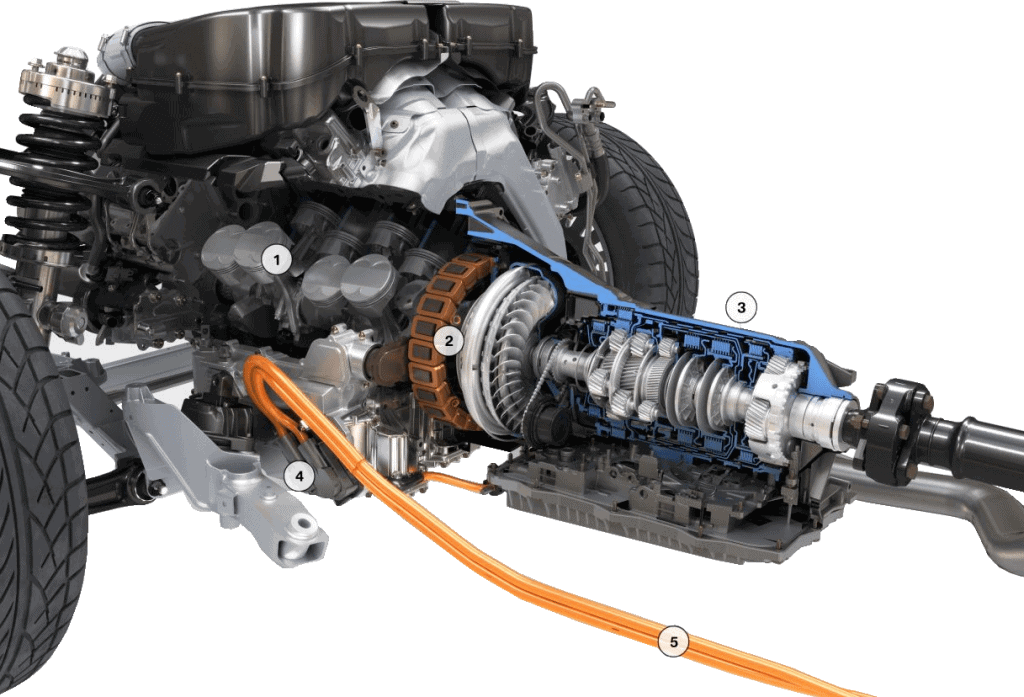
The possible installation positions of the electric motor in a hybrid vehicle are:
- On the combustion engine, where the drive is transmitted via a multi-rib belt or directly via the crankshaft;
- Between the engine and transmission: the input shaft of the transmission is driven by the electric motor;
- Integrated into the transmission;
- At the differential;
- At the wheel hubs (hub motor).
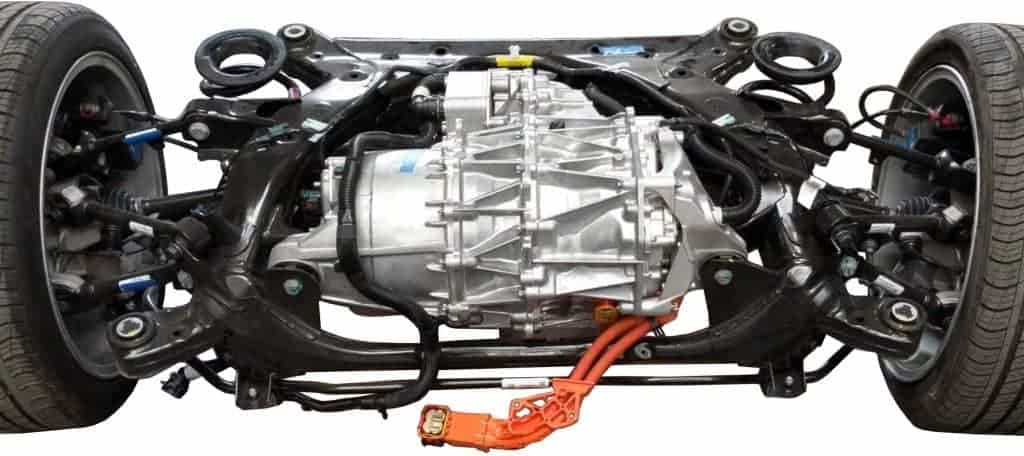
The electric motor of a fully electric car is often mounted on the rear axle. In the image below, the electric motor with the inverter in a cylindrical housing and the final drive of a Tesla can be seen.
AC electric motor (synchronous, with permanent magnets):
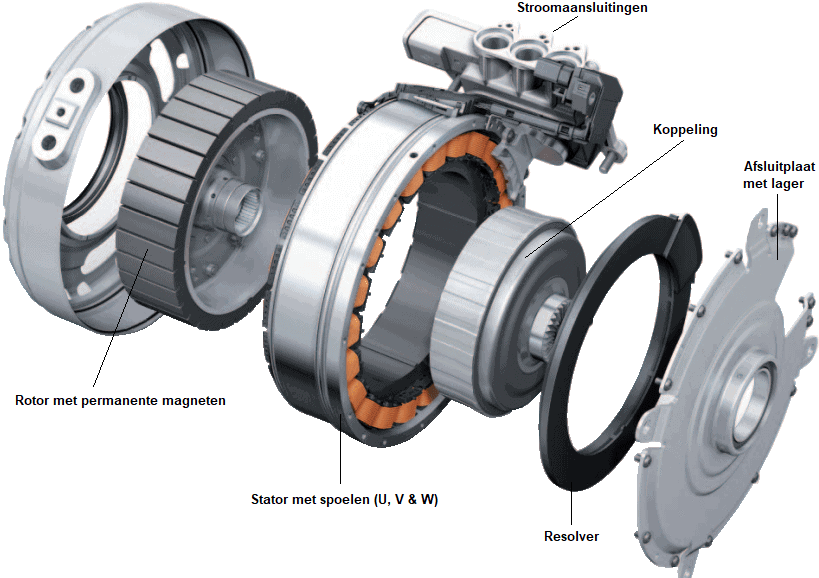
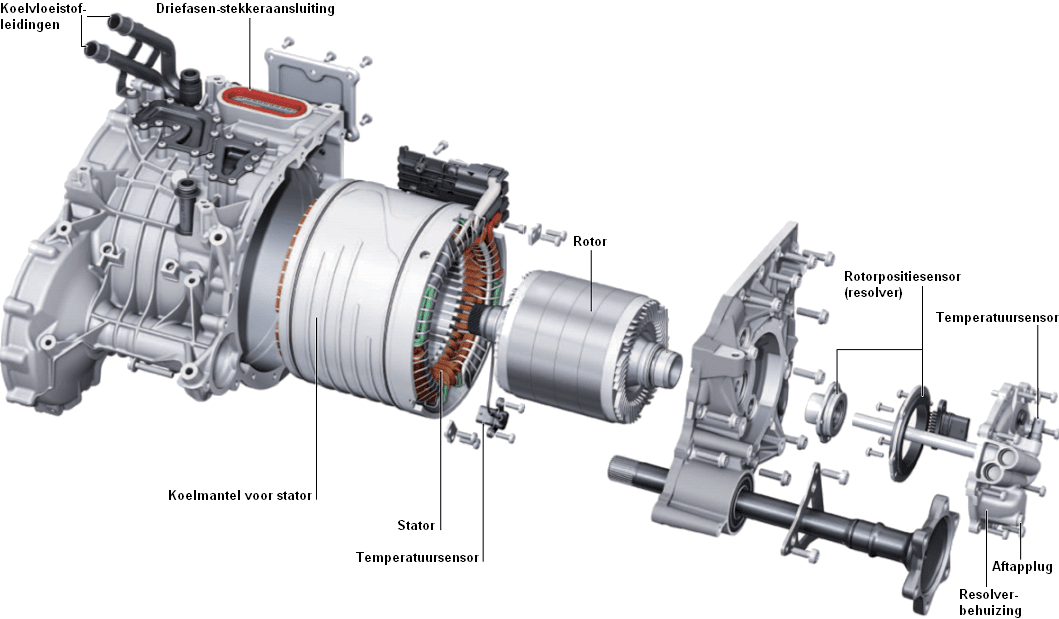
The following image shows the components of a (synchronous) electric motor from an Audi. This type is used in the hybrid variants of the A6 and A8. We will briefly list the components. In the following paragraphs these components are described in detail.
The rotor with permanent magnets will start to rotate as a result of a change in the magnetic field in the stator. The rotor is connected to the clutch which (in cooperation with a clutch that is not shown) can connect or disconnect the combustion engine and electric motor under different operating conditions. The position of the rotor is measured by the resolver: this data is important for the IGBT drivers to control the stator windings at the correct moment.
The permanent magnet electric motor can be controlled with both DC (direct current) and AC (alternating current).
The synchronous motor is one of the most commonly used electric motors in hybrid or fully electric vehicles. This type of electric motor consists of a stator with windings and a rotor with several permanent magnets. The rotor rotates at the same speed as the magnetic field of the stator. The control of the synchronous motor can be implemented as follows:
- AC: controlled by a sinusoidal signal (alternating current).
- DC: controlled by a square or trapezoidal signal (direct current)
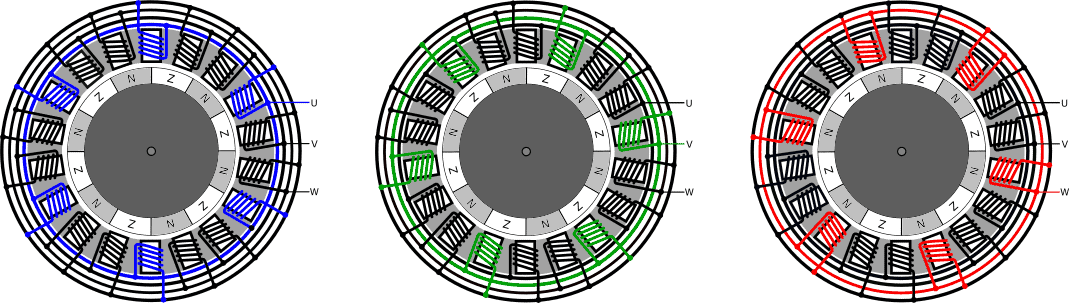
The stator of the synchronous motor consists of three stator coil groups: U, V and W. Each group contains three sets of six parallel-connected coils that are distributed over the entire circumference of the stator. Every third coil belongs to the same series.
- U coils: blue
- V coils: green
- W coils: red
The rotor contains several permanent magnets. By energising alternating coils in the stator, a rotating magnetic field is created. The rotor follows the rotating field and therefore starts to rotate.
AC control of the synchronous motor:
AC control uses frequency-controlled drive or sinusoidal commutation. The stator windings are supplied with a varying three-phase sinusoidal voltage to make the rotor rotate.
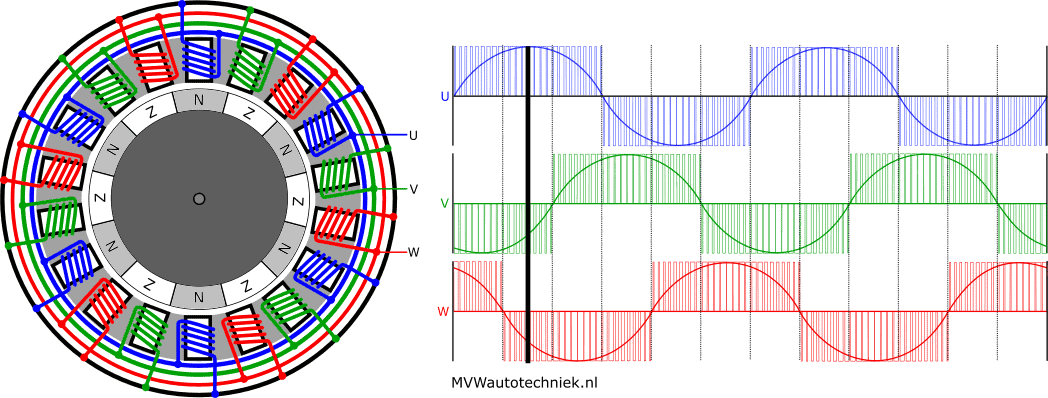
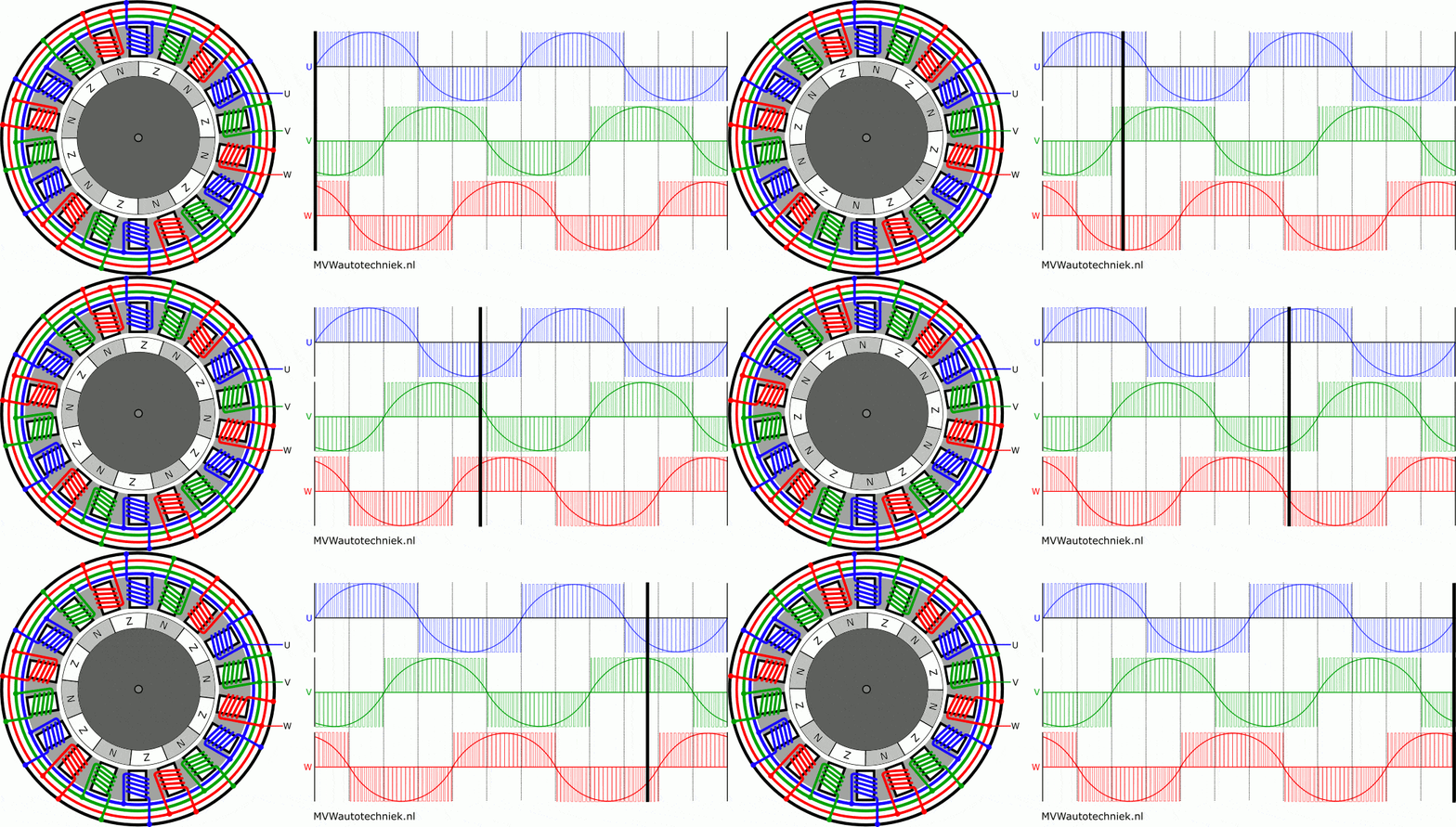
The image below shows the rotor position with a maximally energised U coil. Due to the magnetic field, the north poles have come to lie directly opposite the energised U coils. The cursor in the graph next to the electric motor indicates the control of the coils at that moment.
For information: in the explanation the rotor rotates clockwise when the stator windings are energised.
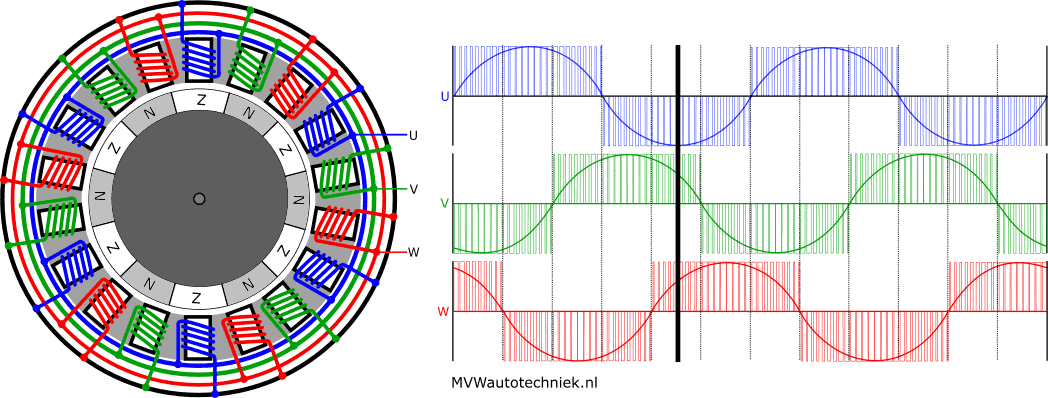
In the next image, the sine wave, thus the alternating current through the U coil, is at its maximum negative value. With this control, the south poles of the rotor are directly opposite the energised (U) stator coils.
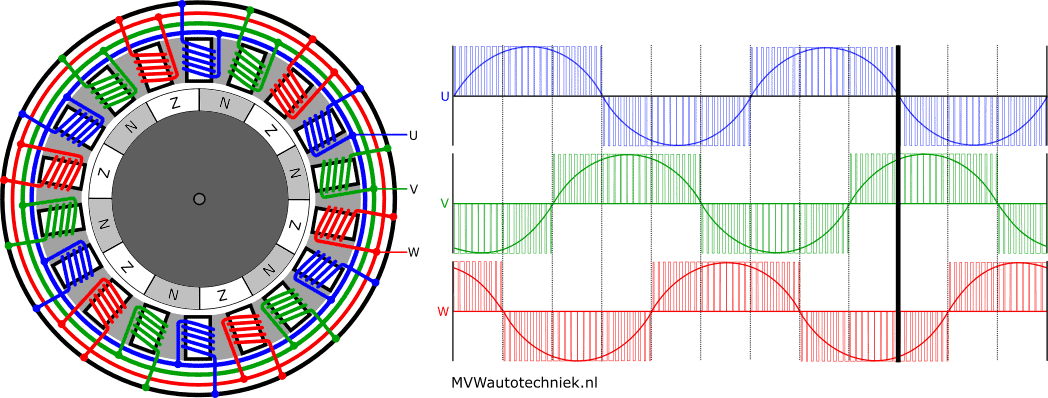
In reality, there is a small air gap between the north and south poles of the rotor. During the transition from the south to the north pole, the current direction in the U coil reverses. Furthermore:
- The current through the V coil (green) is almost at its maximum positive value; the north pole is also almost opposite the coil.
- The current through the W coil has been at its maximum negative value and is rising. The south pole has rotated past the coil.
To give an impression of how the current flows, the animation below shows the rotor rotation as a result of the alternating current.
AC electric motor (asynchronous, induction motor):
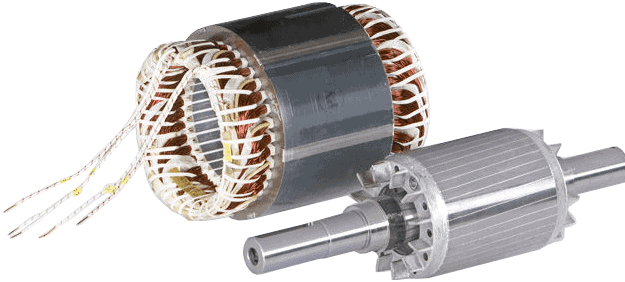
The induction or squirrel-cage motor is an asynchronous motor. The difference between the synchronous motor with permanent magnets and the asynchronous motor lies in the rotor: this is a soft-iron drum with conductors in the longitudinal direction. The rotor runs asynchronously with the stator, which means that there is a speed difference between the rotor and the magnetic speed of the stator. The stator is exactly the same.
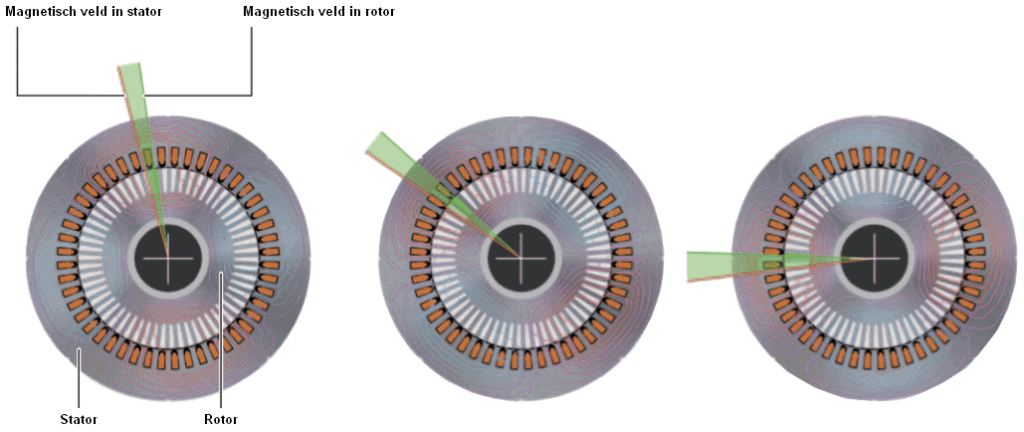
The rotor of the asynchronous electric motor consists of short-circuited windings; the U, V and W windings are connected to each other on one side. When the rotor is in the rotating field of the stator, an induced voltage is generated in the rotor windings. Because the rotor windings are short-circuited, a current will flow. This current ensures that the rotor generates a magnetic field and thus produces torque. Because the operation of the asynchronous electric motor is based on the law of induction, we also call this an induction motor.
The delivered torque affects the slip between the rotating magnetic field in the stator and the rotor speed.
The asynchronous motor has several advantages and disadvantages compared to the synchronous motor.
Advantages:
- Relatively simple, robust and inexpensive rotor;
- High torque at low speed.
Disadvantages:
- Lower power density (per mass) and efficiency. The currents in the short-circuited rotor windings lead to additional rotor losses;
- Speed cannot be controlled very precisely because it depends on the load. This does not necessarily have to be a disadvantage: with a good control system, the speed of the asynchronous motor can also be set;
- High inrush current.
The rotor position and speed of the asynchronous motor are measured by a rotor position sensor. Hall sensors usually provide at least four pulses per revolution of the rotor to transmit the rotor position and speed. We do not refer to this type of rotor position sensor as a resolver, as is the case with synchronous motors.
In contrast to the synchronous motor, the rotor position sensor is not needed to know the rotor position when the motor is at a standstill. However, during operation the rotor position is important: it is necessary to prevent the slip between the rotating magnetic field and the rotor from becoming too great. If the rotating field becomes too fast, a situation can arise in which the rotor suddenly wants to turn in the opposite direction. The forces that result from this can be disastrous for the mechanical and electrical components.
Some manufacturers choose to use a resolver even with an asynchronous motor. The reason for this is unknown to me. The resolver is extremely accurate, both at a standstill and during operation, which may allow for more precise control.
Efficiency maps of the synchronous and asynchronous electric motors:
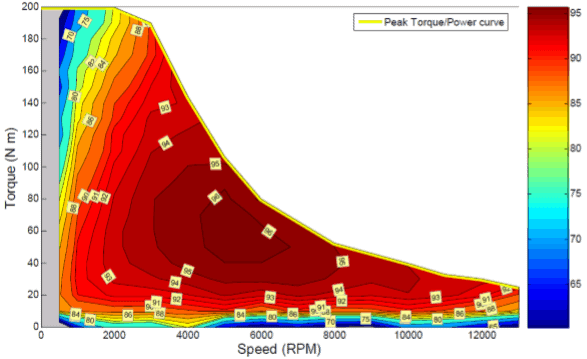
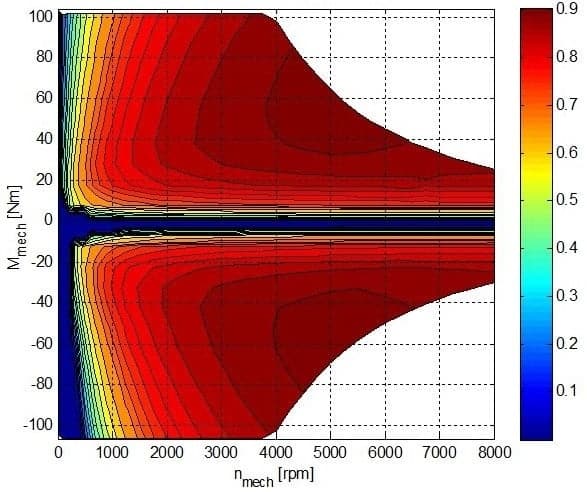
The images below show the efficiency of the synchronous electric motor (left) and the asynchronous electric motor (right).
- The synchronous electric motor is highly efficient. Its efficiency is above 90% over a wide range, with peak values up to 96%. From 2000 rpm onward, field weakening occurs, causing the maximum torque to decrease.
- The asynchronous motor has significantly lower efficiency at lower speeds than the synchronous motor.
Related pages: