
Introduction:
With plug-in hybrids and fully electric vehicles we talk about capacity and power. When purchasing a vehicle, this data is important, because it allows us to determine, among other things, the range and the charging times. For many people the following question is decisive when choosing a car: How many kilometres does a vehicle drive on one battery charge, and how quickly is the battery charged from empty to full? We often find the units kW and kWh, but there is often confusion about what this actually means. On this page we look at the meanings of capacity and power, and the units kW and kWh. In addition, it also describes what the consumption of an EV entails, and in which three ways we may encounter the consumption in the instructions or in the display of the trip computer.
Range:
The range indicates the distance that a vehicle can cover on one tank of fuel or one full battery charge. The range is expressed in kilometres. There are many factors that have a negative effect on the range. Below are a number of points to take into account:
- driving style: when accelerating quickly and decelerating incorrectly using the engine:
– internal combustion engine: during deceleration the engine does not inject fuel;
– electric vehicle: during gentle braking, energy is recovered to the battery. With hard braking, braking energy is “lost” because the brake pads are pressed against the discs; - vehicle weight: more weight results in higher consumption;
- aerodynamics: with a bike rack or roof box, consumption increases as a result of air resistance;
- low tyre pressure;
- low outside air temperature;
- many switched-on electrical consumers (think of seat heating or electric heating);
- air conditioning switched on.
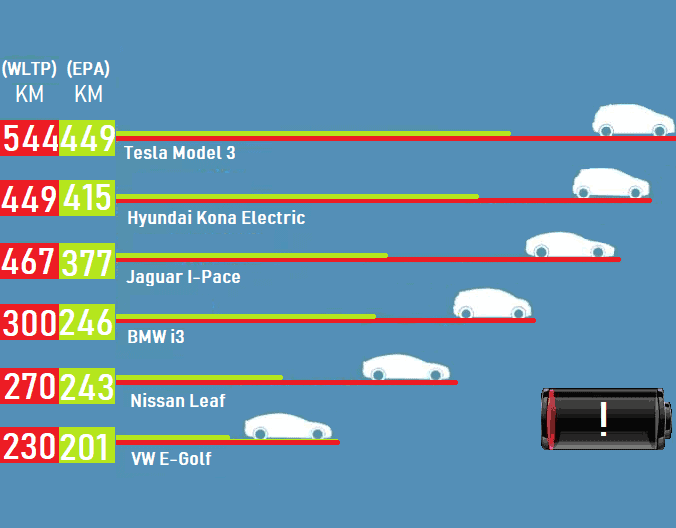
The driver has a lot of influence on the range. When the above points are taken into account, the vehicle’s consumption can be reduced and a higher range can be achieved.
Power [kW]:
Power is the amount of energy that can be delivered in one second. We express energy in joules. 1 J/s (joules per second) is equal to 1 Ws (watt-second). The term watt-second is uncommon; we use the unit “watt”.
1 kW = 1000 watts = 1000 J/s = 1000 joules in 1 second.
With electric vehicles we encounter the power when charging or discharging the vehicle and the power delivered to the wheels:
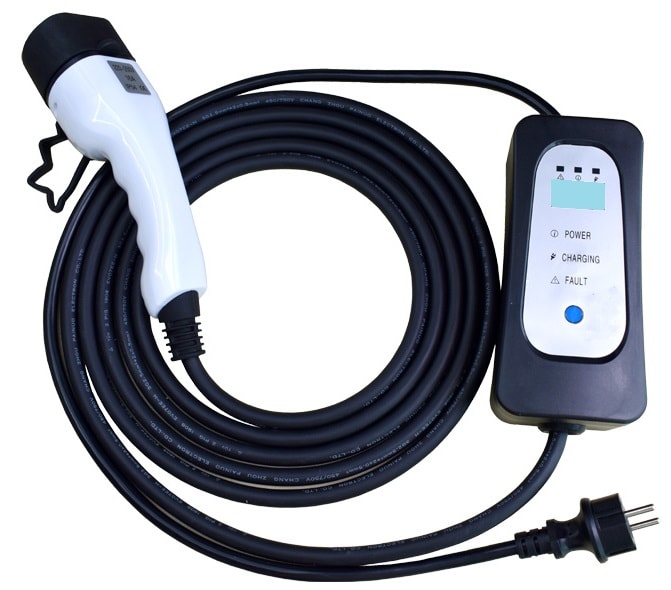
- charging via an emergency charger (mode 2) at home in the wall socket with a power of 2.3 kW;
- charging via a fast charger along the motorway (mode 4) with a power of 43 kW;
- the power delivered by the electric motor (torque multiplied by the angular speed) where losses in the driveline have not yet been taken into account:
– BMW iX3: 210 kW;
– Peugeot e-208: 115 kW;
– Volkswagen ID.5: 128 kW.
Capacity [kWh]:
Capacity indicates the amount of energy that can be stored in a battery. The higher the capacity of the battery, the greater the range will be.
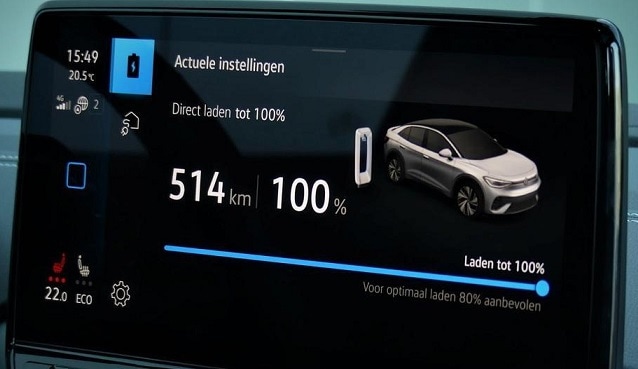
With electric vehicles we often see kilowatt-hours [kWh] used as a measure of energy and battery capacity. As an example, the capacity of three fully electric vehicles is shown:
- BMW iX3: 74 kWh;
- Peugeot e-208: 50 kWh;
- Volkswagen ID.5: 77 kWh.
The capacity in kilowatt-hours is determined by three factors:
- Kilo: multiplication factor x 1000;
- Watt: unit of power;
- Hour: one hour has 60 minutes of 60 seconds, so a total of 3,600 seconds.
One kilowatt-hour [kWh] is equal to 3,600 kilowatt-seconds [kWs].
Consumption [Wh/km, km/kWh, kWh/100 km]:
The charging power, consumption and delivered power of electrical appliances are often given in the unit “watt”. When we run a device with a consumption of 100 watts for an hour, this device has consumed 100 watt-hours (Wh) of energy. If you leave this device on for ten hours, it has consumed a total of 100 watts * 10 hours = 1,000 watt-hours (1,000 Wh), which is equal to 1 kWh (1 kilowatt-hour).
When calculating the costs to fully charge a battery, we multiply the capacity of the battery (in kWh) by the price per kWh.
To calculate a vehicle’s consumption, we divide the capacity (converted to watt-hours) by the number of kilometres that the vehicle can drive before the battery is empty. In vehicle specifications, consumption is often given in Wh/km.
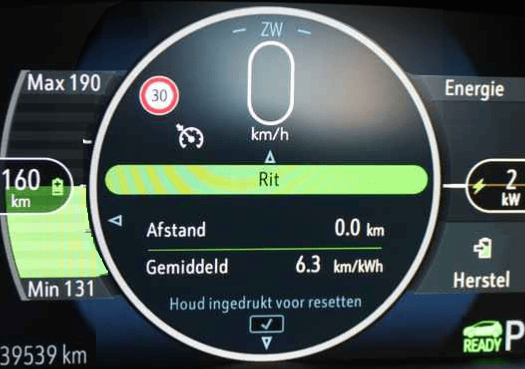
The vehicle’s instrument cluster can also display the consumption in km/kWh or kWh/100 km. This corresponds to how we can see the consumption of an internal combustion engine in terms of km/l (kilometres per litre) or l/100 km (litres per 100 kilometres).
These consumption values can be converted into one another.
In the columns below, the three types of consumption displays are explained and the general formula with values filled in is shown for each type of display.
Wh/km:
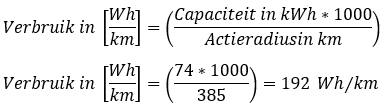
The HV battery of the BMW iX3 has a capacity of 74 kWh. The consumption of this car is 192 Wh/km. This indicates how many watt-hours (0.001 kWh) the car consumes per kilometre. The BMW iX3 can travel about 385 km on its 74 kWh battery.
The consumption is therefore: 74,000 Wh / 385 km = 192 Wh/km.
Km/kWh:
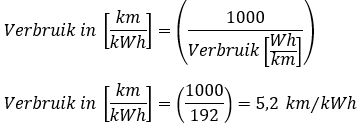
The consumption monitor in the instrument cluster or the trip computer can indicate the current or average consumption in km/kWh. In the case of the BMW iX3 with a consumption of 192 Wh/km, we divide the number 1000 (kWh) by 192 (Wh). The ratio is 5.21. Per kWh, 5.21 km can be driven. The instrument cluster will therefore also display a consumption of 5.2 km/kWh. Of course, this concerns the average consumption, and the actual consumption depends on the driving conditions.
kWh/100 km:
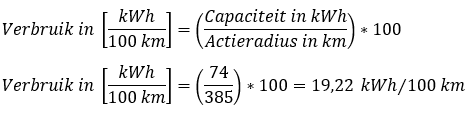
The consumption of the BMW iX3 can also be expressed in kWh per 100 km. The car has a battery capacity of 74 kWh and a range of 385 km. The consumption is calculated as follows: 74 kWh / 385 km.
When we divide the capacity by the range and then multiply the result by 100 ((74 / 385) * 100), we get the number 19.22.
This means that the consumption is 19.22 kWh per 100 km.
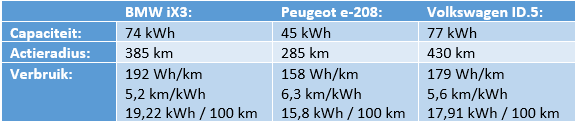
The following table shows, for the three cars mentioned earlier, the capacity, range and consumption in the three different ways.
An overview with examples about charging EVs is described on the page: Charging electric vehicles.
Related pages: