Indicated power (Pi)
The power that is generated by the combustion is called the indicated power. The English term for “geïndiceerd vermogen” is Indicated Mean Effective Pressure, abbreviated as: IMEP. This internal power is determined from the indicator diagram.
In the images below, the same indicator diagram is shown. The one on the right represents the calculation of the surfaces: the positive (blue) and the negative surface (green). When we have determined the relative surface area (positive minus negative), we speak of the mean combustion pressure. In practice this is calculated mathematically by means of integral calculations.
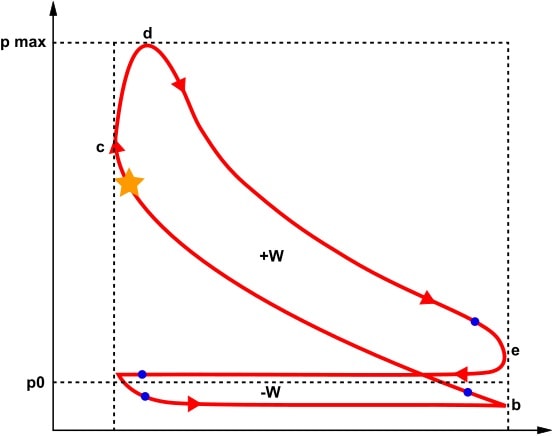
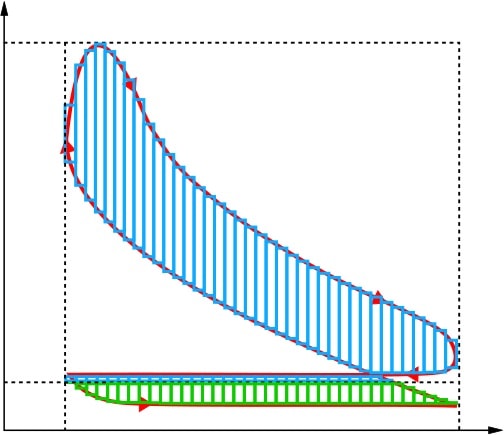
With the indicated power we look at the mean surface area in the indicator diagram. The power measured at the crankshaft will be lower due to mechanical losses.
Effective power (Pe):
The effective power (in English: Brake Mean Effective Pressure, abbreviated as BMEP) is the power that remains from the indicated power after subtracting the friction losses.
With this formula we are going to calculate the power that the engine delivers to its flywheel at the engine speed at which the torque is highest. The effective power will be lower than the indicated power, because there are friction losses occurring from the piston to the wheels, and auxiliary units such as the oil pump, coolant pump and alternator absorb power while the engine is running. The formula is as follows:

Where:
- Pe = total delivered power;
- pe = mean effective pressure;
- Vs = displacement;
- z = number of cylinders;
- i = 1 for two-stroke and 0.5 for four-stroke;
- n = engine speed.
For the calculation we use the following data:
- Mean effective piston pressure: 1400000 N/m² (= 14 bar);
- Displacement: 1.59 dm³ (0.3975 dm³ per cylinder);
- Number of cylinders: 4
- 4-stroke
- Engine speed: 3000 rpm.
The calculation again shown below:
We fill in the data and do not yet take scientific notations into account.
Important: we convert the displacement per cylinder from dm³ to m³ (divide by 1000, see: Calculating volume). 0.3975 dm³ then becomes: 0.0003975 m³.


It follows that the engine delivers a power of 55.7 kW at the given engine speed.
In the previous example the mean effective pressure (pe) was given and the delivered power (Pe) was requested. However, we cannot easily determine pe. There is in fact no measuring equipment for this. With a given Pe and unknown pe, we can still find this by rearranging the formula. We will do this in the following example.
Data of an engine:
- Maximum power: 147 kW at 5700 rpm;
- Bore: 82.5 mm;
- Stroke: 92.8 mm
We fill in the data in the formula:

We rearrange the formula so that the unknown is on the left side of the equals sign:

We convert the result to the pressure in bar:

I.S.O. power:
The I.S.O. power is determined on the engine test bench, where the manufacturer runs the engine under the following operating conditions:
- ambient air pressure (p) = 1 bar;
- air temperature (T) = 300 K = 26.85 degrees Celsius;
- relative humidity (RH) = 60%;
- coolant temperature at the inlet of the charge air cooler (Ti) = 300 K = 26.85 degrees Celsius;
- Lower calorific value / heating value (H0) = 42 MJ/kg.
Related page: