Topics:
- Comparison of theoretical and actual work process
- Indicator diagram
- Pressure curve during the four-stroke process of a petrol engine
- Pressure curve during the four-stroke process of a diesel engine
- Pressure curve under varying operating conditions
- Flow loss
- Influence of ignition timing on indicator diagram
- Pressure curve in the p-α diagram
- Peak gas pressure
- Mean gas pressure
Comparison of theoretical and actual work process:
In the work process of a petrol or diesel engine, we use a PV diagram (P = pressure, V = volume) that indicates the relationship between the pressure and volume in the four-stroke process. You can find more information on the page: Seiliger process.
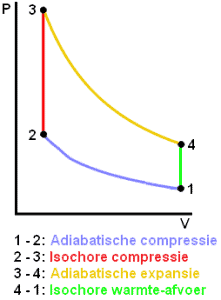
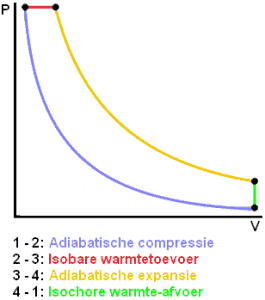
The theoretical cycle process takes place in an ideal engine in which no residual gases or losses are present. In reality, the theoretical work process differs from the actual work process due to the following deviations:
- the cylinder contains not only fresh charge, but also residual gas from the previous working cycle;
- incomplete combustion of the fuel;
- combustion does not occur exactly at constant volume or constant pressure;
- heat exchange between the gas and the cylinder wall;
- flow losses occur during gas exchange;
- there is always (minimal) gas leakage past the piston rings;
- the specific heat changes with pressure and temperature, which affects the combustion.
The course of the actual work process is recorded with the indicator diagram.
Indicator diagram:
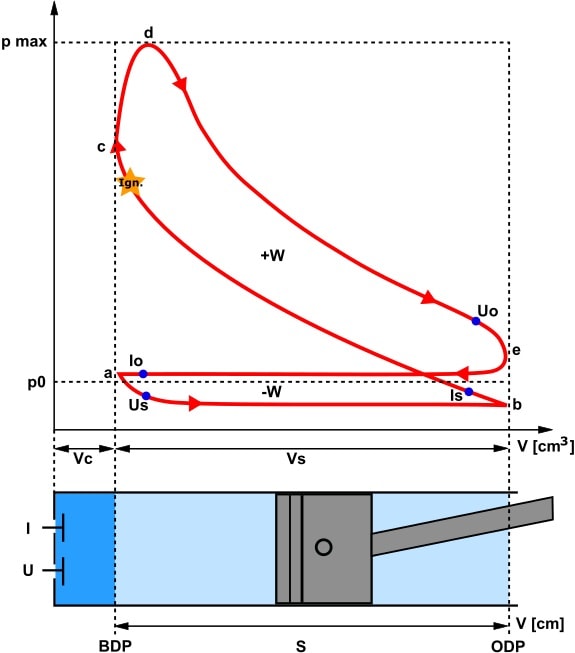
The indicator diagram shows the gas pressure in the cylinder (above the piston) during two crankshaft revolutions. The diagram is determined during a pressure measurement that takes place in the cylinder.
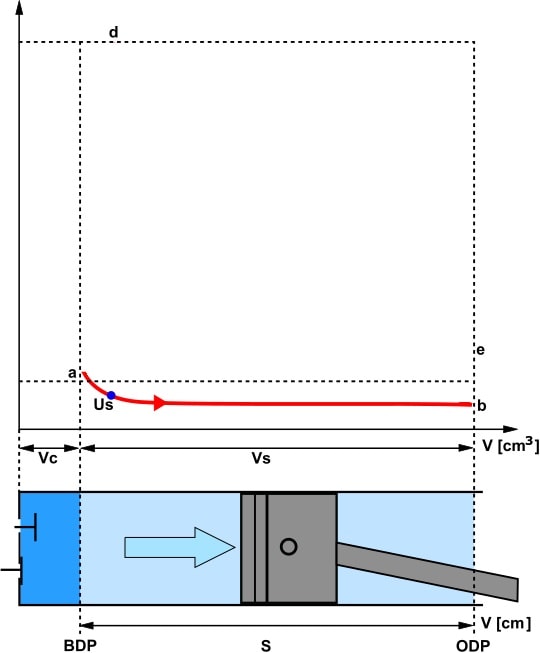
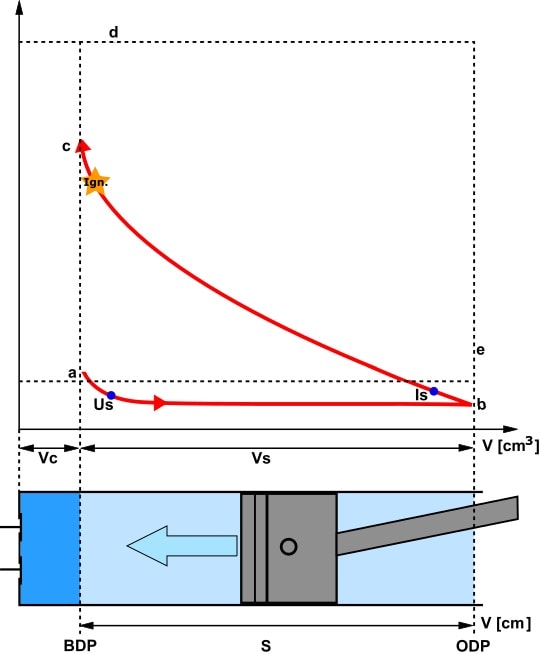
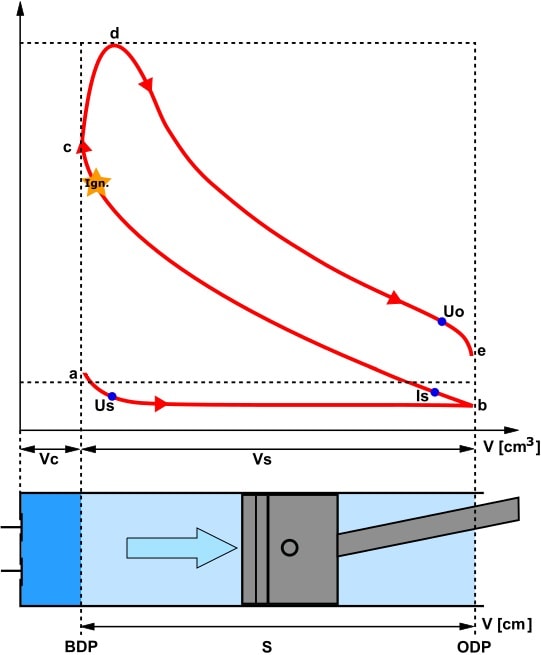
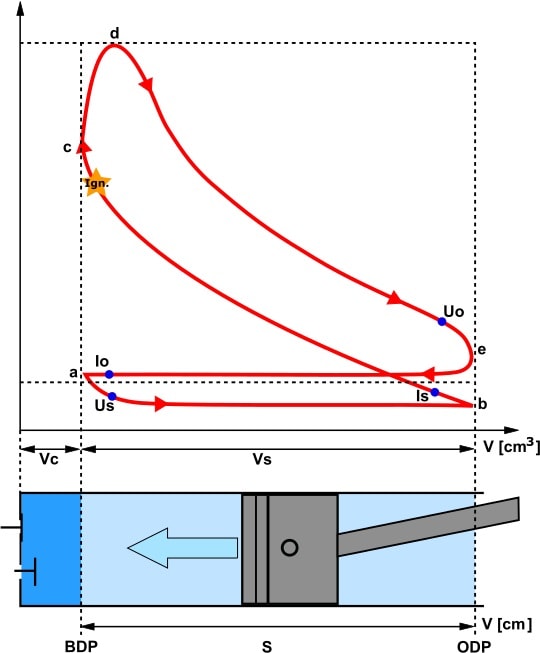
The depicted indicator diagram is from a petrol engine. The red line shows the pressure curve relative to the piston stroke. In an actual measurement, a value is obtained at p Max. We will come back to this later. Below the diagram, you can see a cylinder with a piston. The letters Vs and Vc indicate the swept volume and the compression volume.
Here is a list of abbreviations used in the image:
- p0: atmospheric air pressure;
- pmax: maximum pressure in the cylinder;
- S: piston stroke;
- Vs: swept volume;
- Vc: compression volume;
- W: work (+ positive and – negative);
- Ign: ignition timing;
- Io: inlet valve opens;
- Us: exhaust valve closes;
- Is: inlet valve closes;
- Uo: exhaust valve opens
Pressure curve during the four-stroke process of a petrol engine:
We can look at the indicator diagram in four different situations:
- Intake stroke: the piston moves from BDC to TDC and draws air in. The volume increases because the space above the piston becomes larger and larger.
The pressure remains constant*. In the indicator diagram, the red line runs from a to b; - Compression stroke: the piston moves upwards and compresses the air. The air volume decreases while the pressure increases. The red line shows this between points b and c. Ignition takes place at the end of the compression stroke;
- Power stroke: after the spark plug fires, it takes some time before the mixture has completely burned. We see this process between points c and d. Due to the force released by the ignition, the piston is pushed down. The volume increases and the pressure decreases. We see this between letters d and e;
- Exhaust stroke: the exhaust valve opens and the piston pushes the exhaust gases out. The volume decreases, the pressure remains constant (e to a).
Manufacturers of hybrid vehicles are increasingly applying the Atkinson-Miller principle to reduce the mechanical resistance during the compression stroke. This is visible in the rising line of the compression stroke in the indicator diagram.
*In the explanation we speak of a constant pressure during the intake stroke. This is only partly correct. During the intake stroke, piston acceleration is at its maximum at approximately 60 degrees after BDC. The incoming air cannot follow the piston. At that moment, the maximum vacuum of about -0.2 bar occurs. After that, the cylinder pressure rises again. The mass inertia of the incoming air ensures that air continues to flow into the cylinder while the piston is already moving upwards again. The magnitude of the vacuum depends on the position of the throttle valve and the engine speed. A more closed throttle valve results in a greater vacuum at a constant engine speed. In the above text and images, we have disregarded the increased vacuum during maximum piston acceleration.
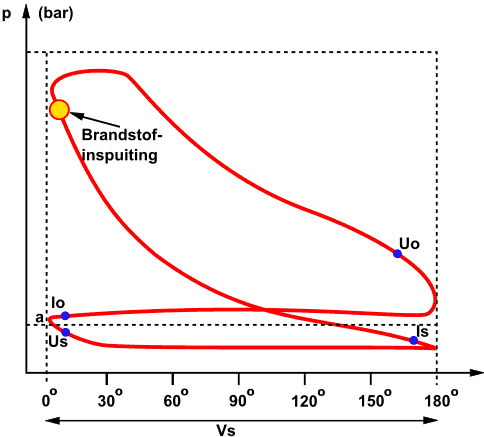
Pressure curve during the four-stroke process of a diesel engine:
Next to this we see an indicator diagram of a diesel engine.
- intake stroke: the piston moves from BDC to TDC and draws in air (if the engine is equipped with supercharging);
- compression stroke: the piston moves towards TDC. The air is compressed and the temperature rises to more than 100 degrees Celsius due to the pressure increase. At the end of the compression stroke, the diesel fuel is injected. The fuel injection starts 5 to 10 degrees before TDC and ends between 10 and 15 degrees after TDC;
- power stroke: because diesel fuel has been injected at the end of the compression stroke, it starts to burn while the pressure remains constant. The pressure in the (nearly) horizontal section remains constant while the volume increases.
In the power stroke we see the isobaric heat supply from the theoretical cycle process.
Just like with the petrol engine, we see that the exhaust valve opens before the piston has reached TDC. Valve overlap also occurs because the intake valve opens earlier than the exhaust valve closes.
Pressure curve under varying operating conditions:
In addition to the engine characteristics determining the indicator diagram, the operating conditions (read: engine load) also have an influence. A high pressure above the piston is not always present or necessary.
The three indicator diagrams below show the pressure curve in relation to the crankshaft degrees. The diagrams are recorded under the following conditions:
- part load: 3/4 load at n = 4200 rpm;
- full load: at n = 2500 rpm;
- engine braking: at n = 6000 rpm with closed throttle valve.
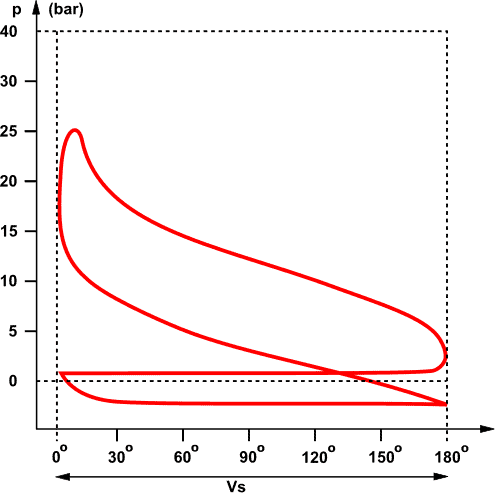
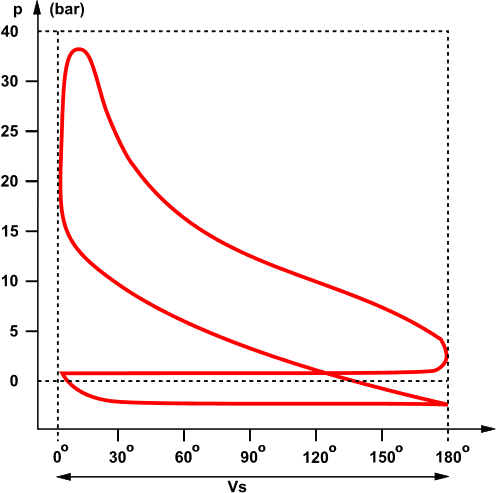
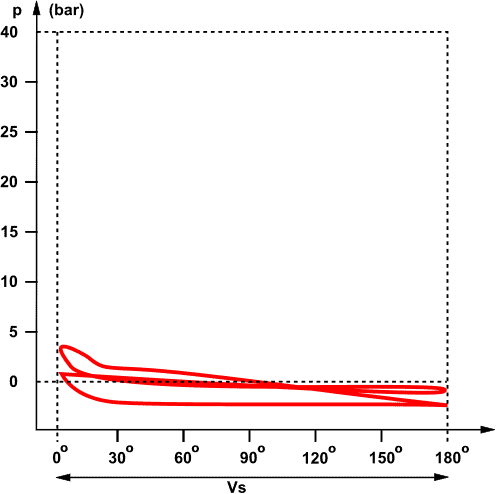
Between part load and full load we see differences in the maximum gas pressure in the cylinder. During engine braking the throttle valve is closed and there is a high vacuum in the intake tract and in the cylinder. Because of this vacuum, the compression pressure is no higher than 3 to 4 bar.
Flow losses:
During the intake stroke a vacuum occurs in the cylinder. Drawing in the air costs energy. This can also be seen in the indicator diagram. Between points a and b the red line drops below p0 (the atmospheric outside air pressure). Below this dotted line there is a vacuum (area -W). We call this flow losses or scavenging losses.
The negative work (-W) costs energy and is therefore undesirable. Scavenging costs work. The exhaust pressure is higher than the intake pressure. The scavenging loop rotates counterclockwise in naturally aspirated engines.
Manufacturers use techniques to limit the flow losses:
- variable valve timing;
- fast and large valve opening;
- optimal sizing of intake ports;
- smooth transition of the ports in the intake tract (avoiding sharp transitions);
- boost pressure (by means of a turbo and / or mechanical supercharger).
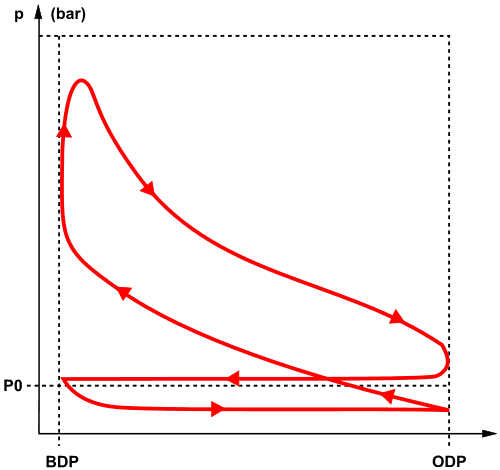
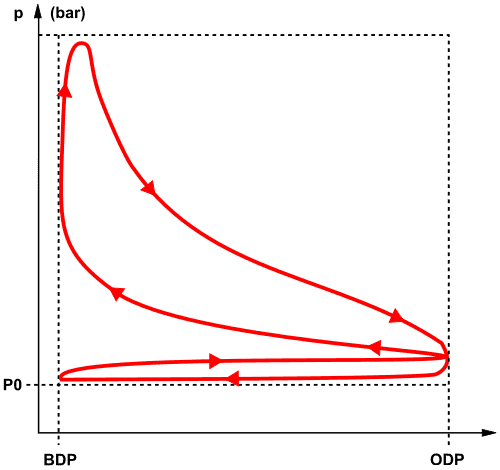
Engines equipped with boost pressure have little or no negative pattern in the indicator diagram. The scavenging loop rotates clockwise and now delivers work. The boost pressure helps during the intake stroke to push the piston downwards (from TDC to BDC). The required compressor work is taken from the exhaust gas, because the turbo’s compressor wheel is driven by the turbine wheel. This makes engines with boost pressure, compared to naturally aspirated engines, significantly more efficient under the same conditions.
Influence of ignition timing on the indicator diagram:
To achieve the lowest possible fuel consumption and a high efficiency, it is important to achieve the following:
- a short combustion time, i.e. a high combustion speed. This is related to the mixture composition;
- a correct phasing of the combustion relative to the piston movement. This is directly related to the ignition timing. The centre of combustion should be approx. 5 to 10 crankshaft degrees after TDC. The centre of combustion is the heat release that occurs during combustion.
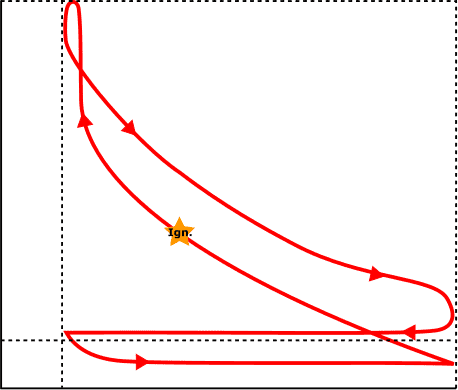
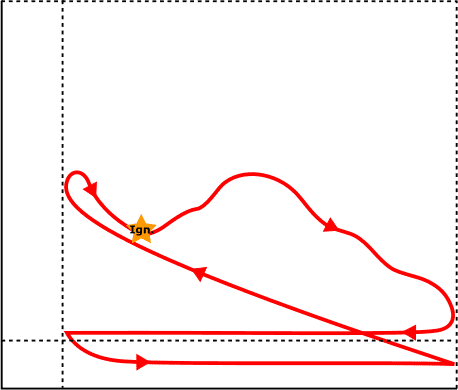
Both too early and too late ignition timing lead to increased heat transfer through the cylinder wall and therefore a reduction in efficiency.
- Ignition too early: the pressure rises too early because combustion starts early during the compression stroke. The piston is strongly decelerated before TDC by the combustion pressure. Ignition that is too early leads to high peak pressures, resulting in a reduction in mechanical efficiency and a risk of engine damage.
- Ignition too late: combustion is initiated too late. The piston is already moving towards BDC, so the pressure in the increasing volume does not become sufficiently high. The still burning gases also flow past the exhaust valves. As a result, the temperature rises too high. A lean mixture produces the same result: the gas burns too slowly. With an excessively lean mixture the gas is still burning at the beginning of the intake stroke. For carburettor engines this can cause backfire for that reason.
A modern engine management system determines the correct ignition timing from its maps: under all circumstances the ignition timing must be as close as possible to the knock limit.
Pressure curve in the p-α diagram:
The indicator diagram can be converted into the tangential force diagram. In this, the tangential force is shown as a function of the crank angle (alpha). We convert the indicator diagram into a diagram in which the pressure (p) is shown as a function of the angle (α): the p-α diagram.
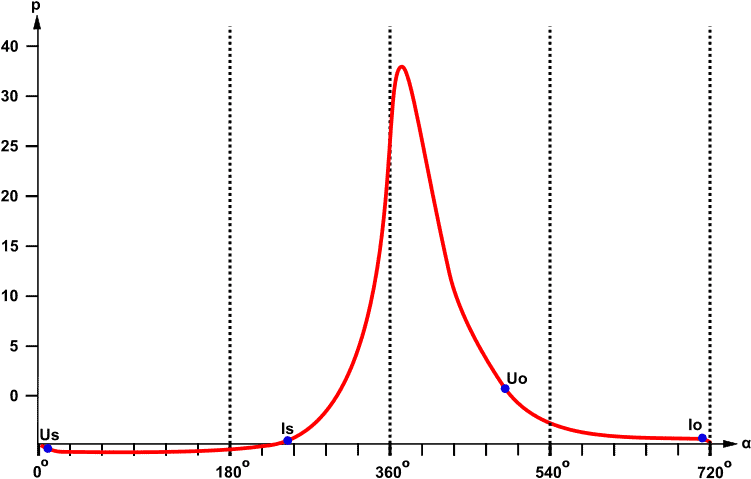
In the following image we see the pressure curve in the cylinder during full load.
The blue points indicate, just as in the paragraph “indicator diagram”, at which moment the valves open and close:
- Inlet valves open (Io) and close (Is)
- Exhaust valves open (Uo) and close (Us).
In addition, from the crankshaft degrees we can see which stroke the engine is performing:
- 0 degrees: TDC (end of exhaust stroke, beginning of intake stroke)
- 180 degrees: BDC (end of intake stroke, beginning of compression stroke)
- 360 degrees: TDC (end of compression stroke, beginning of power stroke)
- 540 degrees: BDC (end of power stroke, beginning of exhaust stroke)
Peak gas pressure:
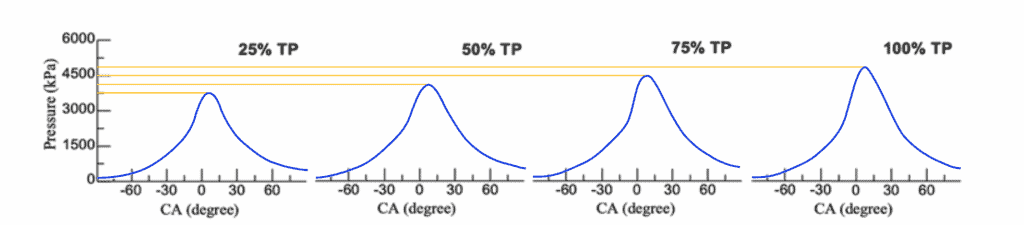
The peak gas pressure is highest during the power stroke. The level of the pressure depends on engine load: when the engine is delivering a lot of power, the combustion pressure will be higher than at part load.
The four images below illustrate this: the throttle opening TP (Throttle Position) gives an indication of how much the engine is loaded in relation to the crank angle CA (Crank Angle). In an average petrol engine, combustion during part load produces a pressure of around 4000 kPa and in full load in this case around 5000 kPa. In engines with stratified injection, camshaft adjustment and variable valve lift, the pressure can rise above 6000 kPa.
Mean gas pressure:
During the working process, the pressure in the cylinder varies enormously. During the intake stroke there is a vacuum (if an exhaust gas turbocharger provides an increased intake air pressure), and after the compression stroke a pressure peak follows. The higher the peak gas pressure, the more powerful the combustion.
To determine the mean pressure of the combustion process, we can divide the indicator diagram into small rectangles with equal widths. The following image shows blue and green rectangles. By calculating the surface area of the blue rectangles we can calculate the positive pressure. We then subtract the area of the green triangles. What remains is the mean piston pressure.
With the mean piston pressure we can determine, among other things, the indicated and effective power of the engine. Visit the page: vermogens, verliezen en rendementen to read more about this.
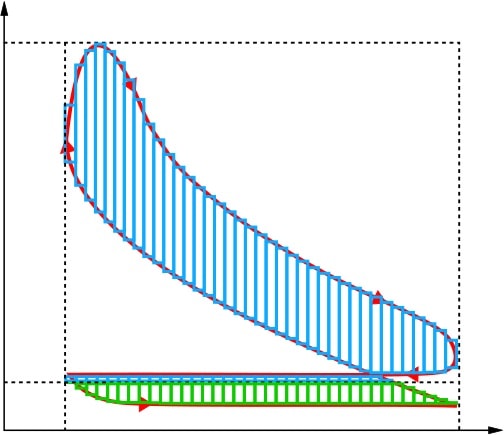
In the image we see that the red line falls outside the blue rectangles: if we were to make the width of each rectangle smaller and thereby place more rectangles next to each other, the deviation would become smaller and smaller. We can apply this to infinity. Of course we are not going to do that in reality. By applying mathematical functions we can determine the area mathematically. We do this by integrating.