Seiliger process:
The Seiliger process is a thermodynamic cycle for combustion engines. Both diesel and petrol engines are based on this, but the resulting pressure curve differs; the diesel is a constant-volume process and the petrol engine a constant-pressure process.
The Seiliger process comes directly from thermodynamics. During the compression of the air, the pressure increases and the volume decreases (the compression stroke). During the power stroke, the volume increases. The volume decreases during the exhaust stroke. The Seiliger process is used to determine the Sankey diagram.
Seiliger process:
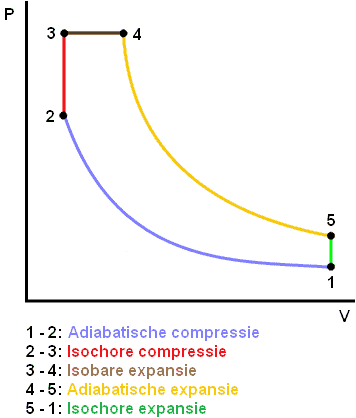
1 – 2: Adiabatic compression: There is no heat exchange with the surroundings. The piston compresses the mixture without the material heating up. All the heat therefore remains in the mixture. (Compression stroke)
2 – 3: Isochoric compression: The volume remains constant and the pressure increases. This is still the compression stroke.
3 – 4: Isobaric expansion: The pressure remains constant and the volume increases (Power stroke).
4 – 5: Adiabatic expansion: Again, there is no heat exchange with the surroundings. The piston moves downwards again (Power stroke).
5 – 1: Isochoric expansion: The pressure decreases at constant volume (Exhaust stroke and Intake stroke).
- Adiabatic: No temperature exchange with the surroundings, the process is reversible.
- Isochoric: Volume remains constant.
- Isothermal: Temperature remains constant.
- Isobaric: Pressure remains constant.
- Isentropic: Reversible process.
Adiabatic compression is often described in books and on websites as isentropic compression. Because the gas cycle in the combustion engine takes place so quickly (by means of the intake, compression and power strokes), there is hardly any time during the compression and power strokes to exchange temperature with the engine materials. Therefore, it is better described as adiabatic compression and expansion. On this page they are therefore referred to as adiabats, not isentropes.
PV diagram of a petrol engine (Otto engine):
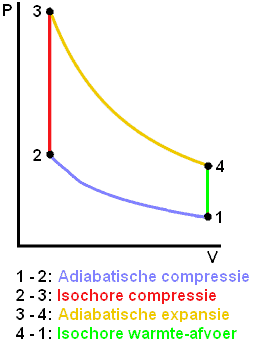
The PV diagram of a petrol engine can be described as a constant-volume process. During the adiabatic compression (from 1 to 2) there is no heat exchange with the surroundings. This is the case for the isochoric compression (2 to 3). The engine materials will heat up as a result. With a diesel engine this is not the case. This is also the reason why a petrol engine reaches operating temperature faster than a diesel engine. The efficiency of a petrol engine also decreases due to the isochoric compression. The adiabatic expansion and isochoric heat rejection are almost identical for petrol and diesel engines.
PV diagram of a diesel engine:
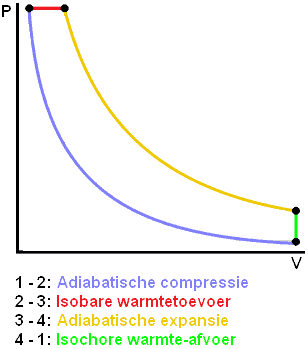
Because combustion in a diesel engine takes place gradually (by means of multiple injections), the pressure does not change as the volume increases.
The isobaric heat addition (2 to 3) is the combustion of the fuel. The area of the diagram (the area between the lines) of a diesel engine is larger than that of a petrol engine. The efficiency of a diesel engine is therefore higher as well.
Theoretical vs. actual cycle process:
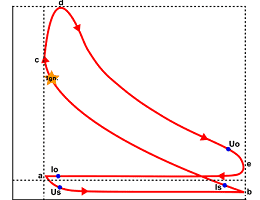
The Seiliger / PV diagrams are for ideal petrol and diesel engines. In reality, the pressures and volumes behave differently, because there are always non-ideal gases and losses. The actual cycle process is shown in the indicator diagram.
Related pages: