Wheel bearing:
A wheel bearing allows the wheel to rotate around its axle. The wheel bearing ensures a smooth transfer of movement between the drive shaft and the steering knuckle. Properly functioning wheel bearings ensure that the wheels can rotate with as little resistance as possible.
Wheel bearings are usually designed as angular contact bearings, deep groove ball bearings or tapered roller bearings (tapered bearings). The different types of bearings are described on the bearings page.
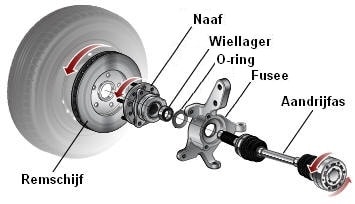
The wheel bearing in the image below is pressed into the steering knuckle. The hub is pressed into the inner ring of the wheel bearing. The wheel bearing therefore connects the rotating hub to the steering knuckle. The drive shaft provides the power transfer from the transmission to the wheel. The outer splines of the CV joint slide into the inner splines of the hub. The drive forces from the drive shaft are thereby transferred to the hub, where the brake disc and the wheel are mounted.
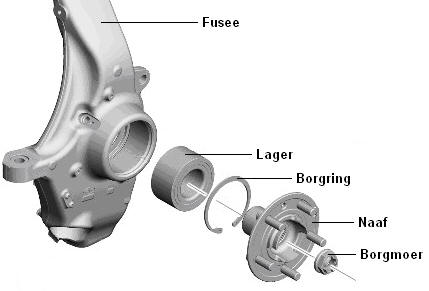
To replace the bearing, the hub must be pressed out of the inner side of the bearing. A bearing puller or a slide hammer can also be used to remove the hub. The bearing will always be damaged in the process, so it must always be replaced after removal. Once the hub has been removed from the bearing, the bearing must be pressed out of the steering knuckle. In the image below you can see an overview of how the bearing and hub are mounted. The lock nut is screwed onto the shaft and ensures that the bearing is mounted under preload.
In the image below, the hub is pulled out of the bearing with a slide hammer.
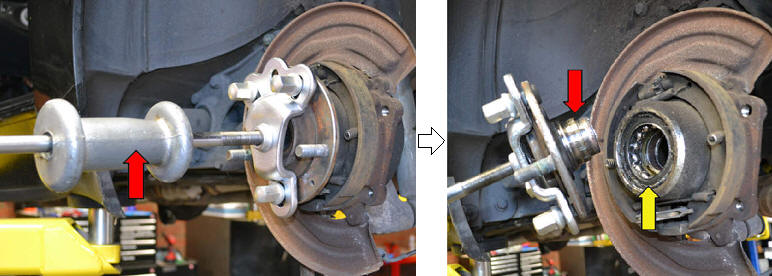
The remaining bearing can be pressed out of the hub with press tools. In almost all cases, the inner ring of the old bearing is still on the hub. If the old hub is to be reused, this ring must be cut or knocked off. There is a risk that the hub will be damaged if this is not done professionally.
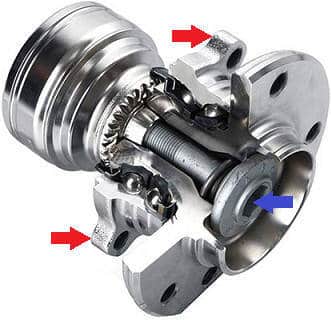
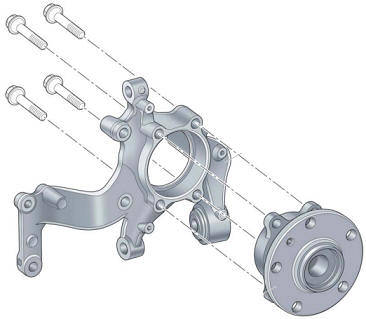
Not all wheel bearings need to be, or can be, pressed. There are also so‑called cartridges, which are bolted as a complete unit to the steering knuckle. Examples of this can be seen in the images below.
To replace this type of wheel bearing on a driven axle, the drive shaft must be removed (secured with the bolt indicated by the blue arrow in the bottom left image) and the bolts of the steering knuckle must be removed (indicated by the two red arrows). These are often four bolts.
Wheel bearing with ABS magnetic ring:
Nowadays, the magnetic ring of the ABS is often integrated into the wheel bearing. In that case there is no longer a toothed ring that is normally mounted against the hub. A magneto‑resistive sensor (MRE sensor), i.e. a Hall sensor, registers the wheel speed because the magnets in the magnetic ring move past the sensor. Based on the speed of the magnetic ring, this ABS sensor sends a square‑wave signal to the ABS control unit.
Compared to the ABS system with inductive sensor and toothed ring, this system has the advantage that the speed is measured from 0 km/h instead of 5 km/h with the inductive sensor. This system therefore already works at lower vehicle speeds.
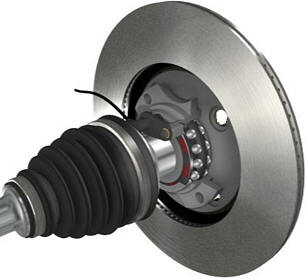
Replacing such a wheel bearing is more complex than replacing a bearing without an integrated magnetic ring. The magnetic ring must of course not be damaged during installation, but the mounting direction also needs to be carefully observed. The bearing can often be installed in two ways. Sometimes the mistake is made of installing the bearing the wrong way round, causing the magnetic ring to end up on the brake disc side. In that case the bearing will have to be removed again. The bearing will be damaged again in the process and a new bearing will be required.
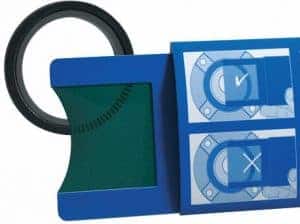
To check whether the magnetic ring is on the correct side, special magnetic cards can be held against the wheel bearing (see image).
Defects and malfunctions:
Wheel bearings can fail for various reasons:
- Age
- Hitting curbs
- Too little grease due to incorrect assembly or a leaking seal
- Sporty driving style
- Driving through industrial areas where iron ore is present and metal shavings can get into the bearing
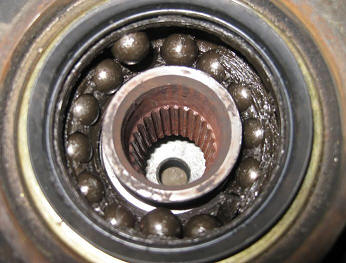
A defective wheel bearing can be recognized by a humming noise that increases at higher vehicle speeds. The humming noise should not be confused with cupped tyres. The noise of a defective wheel bearing often changes when cornering. For example, if a wheel bearing on the left side of the vehicle is defective, the noise will be louder when the left wheels are more heavily loaded. This happens when steering to the right; more lateral forces and weight are then applied to the left wheels. When steering to the left, the right wheels will be more heavily loaded, causing the noise to decrease. If the noise does not change when steering left or right, it is more likely that the tyres are cupped.
In the video, the sound of a defective wheel bearing can be clearly heard.
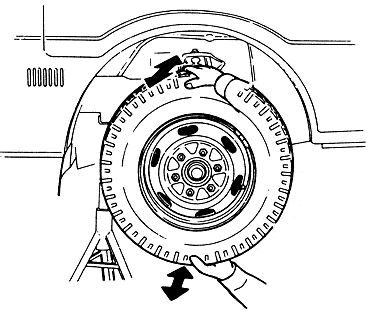
Another defect that can occur with wheel bearings is play. The play can be felt by jacking up the wheel, gripping the tyre at the sidewalls and moving it back and forth (see image).