Heat exchanger used in the engine oil circuit:
The heat exchanger of the oil circuit ensures that in a just-started engine (so not yet at operating temperature) the oil warms up more quickly. The coolant heats up fairly quickly, but the engine oil usually takes twice as long before it reaches the same temperature of about 90 degrees. By using a heat exchanger, the (warm) coolant flows through the housing right alongside the (cold) engine oil, which is thereby warmedup.
When the engine has been at operating temperature for some time and is heavily loaded, the temperature of the engine oil shoots up to above 100 degrees. Due to the operation of the heat exchanger, the opposite effect now occurs: the constant coolant temperature of 90 degrees now cools the engine oil down again as much as possible. That is why this component is called a heat exchanger: at one time it heats the engine oil, at another time it cools the oil.
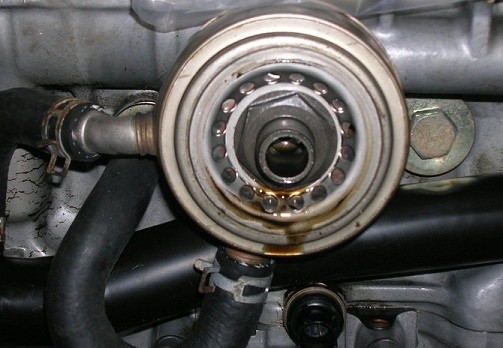
In the image below, a heat exchanger from the engine oil circuit is shown. This is often also called the oil cooler. However, this is not entirely correct, because with a cold engine the oil is actually heated here. The two hoses that are mounted on the housing are coolant hoses. The coolant circulates in the round housing. On this side of the housing, the oil filter is mounted. This oil filter covers the entire front of this housing. The hole on the inside is the supply of engine oil to the filter and from the small holes on the outside, the engine oil is fed back into the engine block.
Other applications with a heat exchanger:
Not only the engine oil is brought up to temperature by means of a heat exchanger. Many other components in the car also work with this principle:
- Radiator: The radiator is also considered a heat exchanger; the coolant temperature is transferred to the air flowing past.
- Heater radiator: The interior air flows through the heater radiator. This has a temperature of around 90 degrees and therefore heats the interior air.
- AC condenser: The warm R134a is cooled by the condenser because, just like with the radiator, the ram air flows through it.
- AC evaporator: The warm outside air flows through the evaporator and is significantly cooled before it is blown into the interior.
- EGR cooler: The exhaust gases that are returned to the engine via the EGR are cooled by the coolant.
- Intercooler: The compressed air from the turbo flows through the intercooler and is then cooled by the outside air before it goes to the engine’s intake.