
Introduction:
To prevent the battery from running down, the quiescent current of a parked vehicle must be as low as possible. Electrical systems such as the central door locking, possibly extended with an alarm system, must always be on standby for a key signal or intrusion detection. A quiescent current of less than 40 milliamps (0.04 A) is acceptable. We also refer to quiescent current as “leakage current”.
When the quiescent current is higher than 40 mA, there is a quiescent current disturbance. An electrical component or system remains switched on while the car is parked. This results in a flat battery after the vehicle has been stationary for some time.
An electrical consumer that causes a quiescent current disturbance, but is not visible or audible, is called a “clandestine consumer”. Another term for this is a “silent consumer”. When a battery is flat after standing still overnight, this does not immediately mean there is a clandestine consumer. The internal resistance of a battery increases as it gets older. At low temperatures the internal resistance increases even more. An old battery may still function fine in summer, but cause starting problems in winter. Lights that were left on are also not included in this; that could easily have been noticed.

With a flat battery, you should of course first check the state of charge and the capacity of the battery. A battery may have become defective after being deeply discharged several times. A new battery will suffer the same fate if the source of the problem is not solved. On this page, the steps are shown that can be taken to trace a clandestine consumer.
Measuring quiescent current:
To be sure that we are dealing with a clandestine consumer, and not with a fault in the battery and / or charging system of the car, we place the current clamp around the battery’s ground cable. The ampere setting on the multimeter can also be used to measure in series, but then care must be taken to connect the multimeter’s test leads to the negative cable and the battery before the battery terminal is removed. If the battery terminal is removed and only then the multimeter is connected, the vehicle will have been without voltage. And that is absolutely not desirable!
In this example, we assume the simplest way to measure the quiescent current: with the current clamp. The following conditions must be met in order to obtain a reliable measurement:
- all consumers must be switched off;
- the car must be in rest mode (sleep mode);
- the doors must be locked. The alarm must not go off.
Because we need access to the fuse boxes in the interior (in the dashboard and sometimes in the trunk), all doors must be opened and the locks must be locked by hand or with a screwdriver. When a car is in rest mode, you must not open any door: the car will be woken up, all CAN and other networks become active, the interior lighting and the display in the instrument cluster will light up, making it impossible to read the quiescent current.
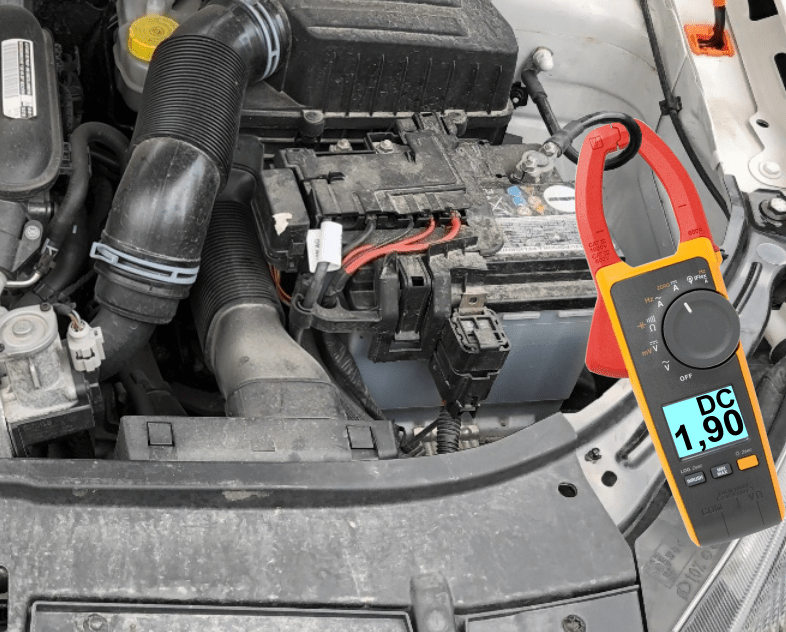
After locking all doors, it can take up to 30 minutes before the vehicle has entered rest mode. We place the current clamp around the battery’s ground cable (see the following image) and read the current.
In the previous paragraph it was stated that the quiescent current must be a maximum of 40 mA (0.04 A). In this example we measure a current of 1.90 A. The quiescent current is too high.
Instead of a current clamp with a digital display, a current clamp can also be connected to an oscilloscope. This allows us to analyze the quiescent current over a time period of several minutes or even hours.
Tracing a clandestine consumer:
In the previous paragraph we saw that the quiescent current is too high. The battery discharges because an electrical component in the car remains switched on. We can search in the fuse box for the fuse that protects this particular component against excessive current. The current of 1.90 A flows through one of the fuses in the fuse box.
A mistake many people make is to pull the fuses out of the fuse box one by one. When they have pulled out the correct fuse, the quiescent current drops to almost 0 A. By looking up the circuit the fuse belongs to, they can see what has remained on. However, in this way a fault may be unintentionally solved temporarily. For example, if this interrupts the supply to an ECU, it may remain free of faults for several weeks or months due to a hard reset. So you do not know for sure whether a fault has been solved temporarily or permanently.
The correct way to investigate whether (too) much current is flowing through a fuse is by measuring the voltage drop across the fuse.
A fuse has an internal resistance. One through which no current flows has a voltage drop of 0 mV. The internal resistance causes a voltage drop at the moment current flows through it. In the following image we see the measurement of the voltage drop across a 20 A fuse.
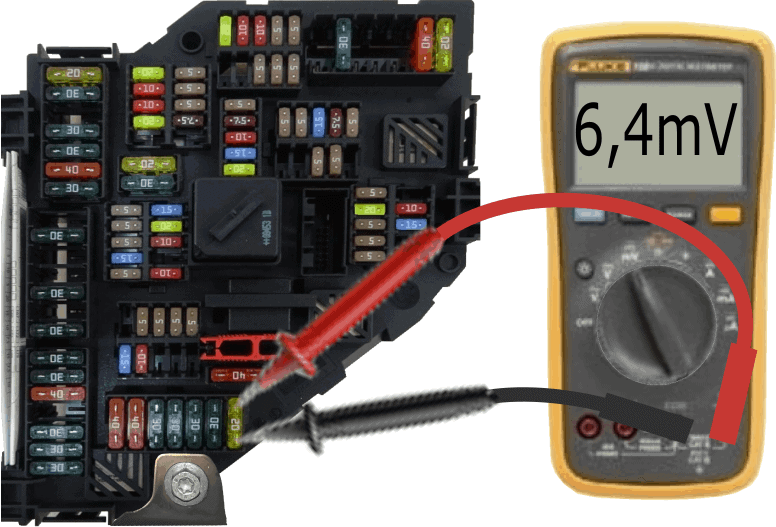
We look up the 6.4 mV voltage difference on both sides of the fuse in the table on the page: voltage drop across fuses. In the table we see that a voltage drop of 6.4 mV across the 20 A standard fuse is caused by a current of 1893 mA.
- the voltage drop of 6.4 mV in the table corresponds to a current through the fuse of 1893 mA. That is: 1.893 A
- the quiescent current measured with the current clamp is: 1.9 A;
- the consumer behind the fuse causes a current of 1893 mA;
- the quiescent current without this consumer is 7 mA;
- in short: the current through the consumer + the quiescent current of the car without this consumer is: 1893 + 7 = 1900 mA = 1.9 A.
In the workshop documentation we look up in the fuse overview what the fuse belongs to. In this example the fuse protects the retrofitted Bluetooth car kit against overload. When the connector of the Bluetooth module is unplugged, the quiescent current immediately drops back to 7 mA. This means that the Bluetooth module remains on.
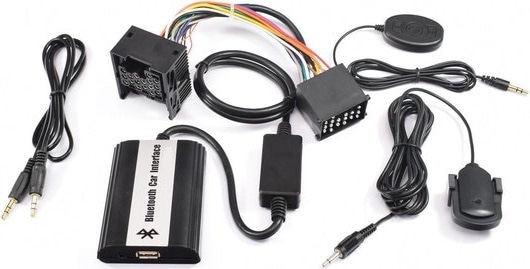
The following image of the Bluetooth module is used as an example to show the module that is hidden behind the dashboard, and therefore cannot be seen whether it is switched on or off. The customer might have noticed this because their phone remained connected via Bluetooth after switching off the car, but there was no other indication. The module will need to be repaired or replaced.
Common causes:
A clandestine consumer is often retrofitted or added equipment that the car was not originally delivered with. Examples include car kits (the example above), retrofitted central locking, devices in the 12-volt socket (possibly hidden in the trunk or center console), or a relay that sticks: terminals 30 and 87 then remain connected, causing a (main) current to keep flowing without the relay being actuated. Also remember to check the glovebox or trunk light; especially in somewhat older cars, these can remain on due to a bad switch without this being detected by an ECU, or being automatically switched off during rest mode.