Introduction:
The fuel pump is a part of the fuel system. The components used are described on the page fuel system petrol engine.
In a vehicle with a petrol engine three types of fuel pumps can be used: the mechanically driven pump, the electric feed pump and the high-pressure fuel pump. This page describes the operation and application of each pump.
Mechanically driven fuel pump:
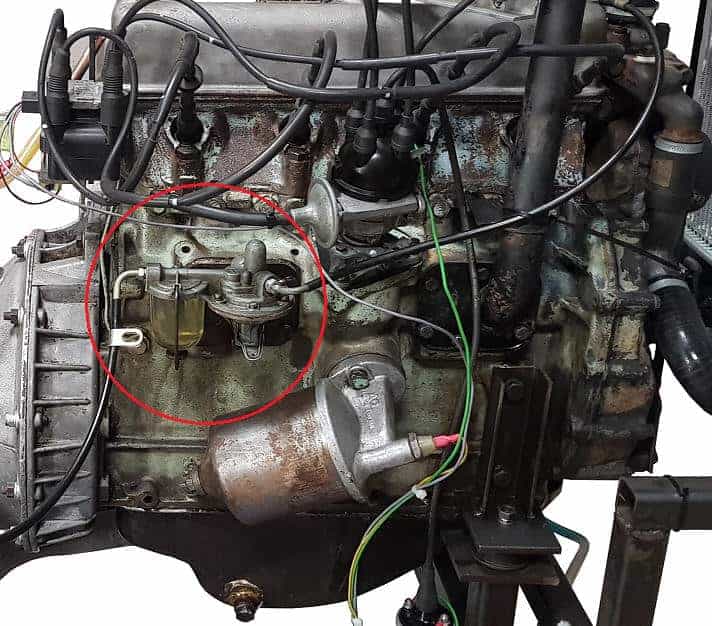
In petrol engines that were equipped with a carburettor, a mechanically driven fuel pump was often used. In the image you can see the mechanically driven fuel pump of a classic Land Rover engine from the 1970s, which was converted to a computer-controlled engine management system in 2017–2018. The fuel pump is circled in red.
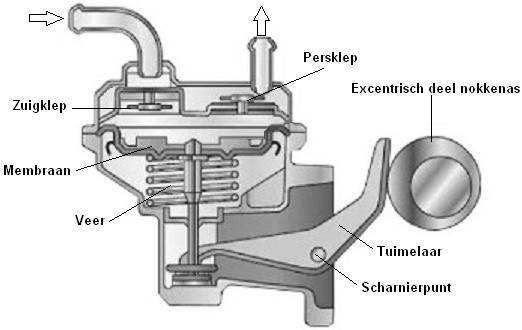
The drive is provided by an eccentric operated by the camshaft. Operating the rocker causes the diaphragm in the middle to be pulled down. The vacuum in this chamber causes the inlet valve to open. The fuel flows into the fuel chamber through the inlet valve. As soon as the eccentric part of the camshaft rotates further, the spring pushes the diaphragm back into its place. The overpressure in the fuel chamber causes the delivery valve to open and the fuel to leave the pump at increased pressure. Via a line, the fuel pump feeds the carburettor.
When the car has been stationary for a long time and/or the float chamber in the carburettor contains insufficient fuel, the fuel can be pumped up with a small lever on the mechanical fuel pump. The lever is connected to the diaphragm, just like the rocker in the image. It is not visible in the image.
Fuel pumps are often equipped with a sight glass that also serves as a sediment chamber. This sight glass must be cleaned regularly. The system with carburettor and mechanical fuel pump, especially versions with a long suction line, are sensitive to vapour lock (vapour lock).
Electric feed pump:
Vehicles with electronic injection use an electric feed pump. The fuel pressure is much higher: 3 bar with the electric pump versus 0.3 bar with the mechanical fuel pump; so ten times as high. The pump also switches on immediately when the ignition is switched on. The fuel system is therefore brought up to the correct pressure straight away before the engine is started.
Nowadays the electric fuel supply pumps are located in the fuel tank. Sometimes they are placed outside the tank, namely between the tank and the fuel rail. The advantage of mounting them in the tank is that the pump is cooled by the fuel in which it is immersed.
Below is a two-stage pump. This is now found in every car. These pumps contain two mutually independent pumps, namely the impeller pump (left image) and the gear pump (right image). Both pumps are driven by separate electric motors. The first stage feeds the fuel from the tank via the filter to the buffer reservoir. This has a capacity of about 600 millilitres. This internal reservoir ensures that when a car takes a long corner with a low fuel level, the gear pump (2nd stage) is still supplied with fuel. If the reservoir were not filled, all the fuel would slosh to one side of the tank, so the pump would no longer be able to draw in anything. This setup prevents that.
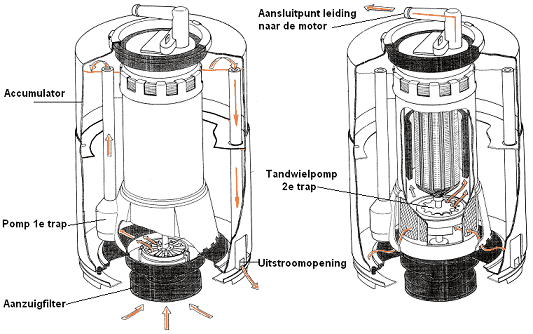
The fuel in the buffer reservoir is fed to the engine by the gear pump at a pressure of up to 3 bar (via the line at the upper connection point). This yields a pump output of 80 litres per hour. This is of course much more than is needed. The reason for this is explained in the text below the image.
The pump supplies much more fuel than the engine actually needs. This is done deliberately, because the system must always remain pressurised. If the system were without pressure, the fuel in the lines could heat up due to external influences. Vapour bubbles (vapour lock) could then form. Keeping the system constantly under pressure prevents this. This means that not all of the fuel pumped to the front is actually used. That is why a return line is fitted. The pressure regulator provides this. This fuel return line runs from the engine compartment back to this fuel pump. The return fuel ends up back in the tank.
The pump therefore always runs at a constant speed. Whether the engine is idling or delivering power, the feed pump will always pump the fuel to the engine at the same fuel pressure. When the engine is idling, more return fuel will flow back to the tank than when the car is accelerating.
Fault symptoms of the fuel pump:
The electric fuel pump makes sure that the fuel is pumped from the tank to the engine. When the pump stops working, the engine will therefore no longer receive fuel. It is not always immediately clear that the fuel pump is no longer functioning properly. In some cases the fuel pump still runs, but no longer achieves the required pressure. With too low a delivery pressure, the following symptoms may occur:
- The maximum engine power decreases.
- Misfiring occurs.
- The engine does not start properly while cranking.
- Fault codes are stored in the ECU.
In many cases there is a low-pressure fuel sensor fitted to the feed line. This sensor sends the fuel pressure value to the ECU. If the fuel pressure is too low, the ECU will store a fault code. If there is no pressure sensor present, the technician must connect a pressure gauge to the fuel rail in case of problems. The pressure gauge indicates the actual fuel pressure. Using the measured value, the technician can determine whether the correct pressure is being reached, or whether the pressure remains too low.
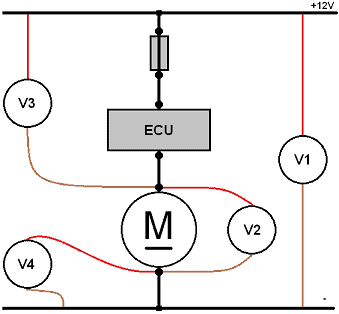
A low fuel pressure does not necessarily mean that the fuel pump is defective. With too low a supply voltage, a poor ground connection or a bad connector, the pump may also receive insufficient voltage to operate correctly. In the case of low fuel pressure it is therefore advisable to measure the voltage at the pump connector while it is running. Never unplug the connector to measure in this case, because that breaks the circuit and a contact resistance will no longer result in a voltage drop!
Example:
There is a contact resistance present in the positive wire. With a V4 measurement (see diagram) you can detect this. The V3 (voltage drop in the positive) shows, for example, 4 volts. That means that the pump has 4 volts less to operate with, and with a supply voltage of 12 volts it therefore functions on only 8 volts (measurement V2). When the connector of the pump is unplugged, the circuit is interrupted and the contact resistance will no longer cause a voltage drop. In that case, 12 volts will be measured in the connector. So there is only a voltage drop with a closed circuit and switched-on consumer, so the connector must not be unplugged from the pump while measuring. Another option is to measure with the connector disconnected but under load using, for example, a separate lamp.
High-pressure fuel pump:
The high-pressure fuel pump of a petrol engine with direct injection is almost always driven by the engine’s camshaft. The pump is then located on top of the valve cover and is easy to access. During repairs, the pump can be easily removed (the fuel rail must first be depressurised). The pump does not operate on “timing” as with a high-pressure pump (in-line pump) of a diesel engine.
The image shows a V8 engine with 8 injectors. The fuel pump is mounted on the valve cover (the valve cover is not visible in the image). Via the fuel supply line (4), fuel is supplied from the feed pump in the tank to both high-pressure pumps at a pressure of 5 bar. When the camshaft pushes the plunger in the fuel pump, a pump stroke is made. The fuel is now forced into the line (9) under high pressure. Via this line, the fuel enters the fuel rail (also called fuel gallery), where it is distributed under equal pressure over the high-pressure lines (7) of each injector.
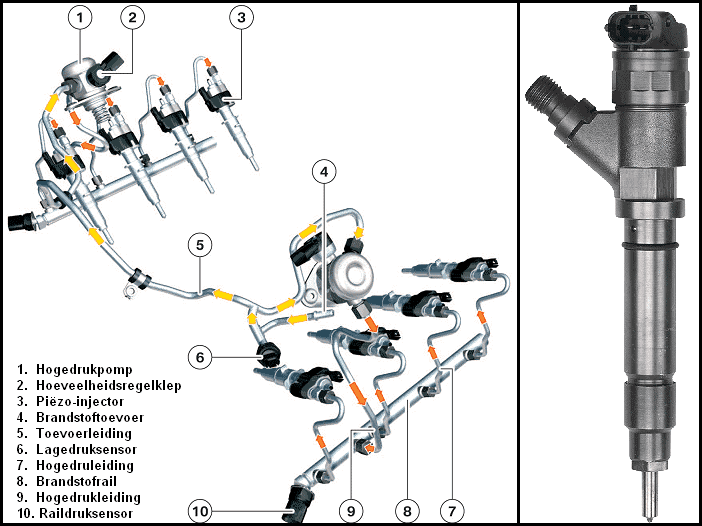
Each injector has a connector. This connects each injector to the engine control unit (ECU). Based on the main maps (which are calculated using the input signals such as temperature sensors and speed sensors) the ECU determines when and for how long the injector injects. The injection pressure is often around 200 bar with a maximum pressure of around 250 bar (depending on make/type).
There is always a rail pressure sensor on each fuel rail, which continuously monitors the pressure in the rail. This data is sent to the ECU, which uses it to control the high-pressure fuel pump. The ECU then determines whether the pump pressure needs to be increased, reduced, or kept the same.
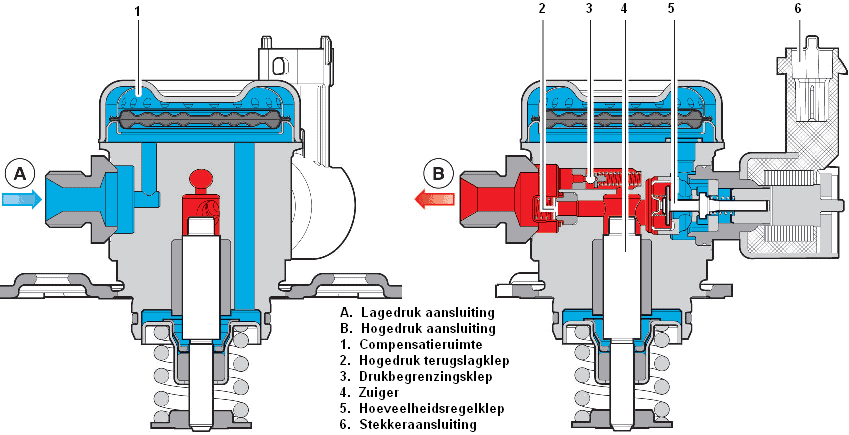
Via low-pressure connection A, fuel from the feed pump in the tank enters the pump. This fuel flows into compensation chamber 1. Through the quantity control valve 5 the fuel enters the fuel chamber.
The plunger 4 is driven by the camshaft. The plunger is in the lower position (in the neutral state), because the spring pushes it downwards. The camshaft pushes the plunger upwards against the spring force. The fuel is forced through the high-pressure check valve into the line (via connection B). The pressure-limiting valve (3) opens when the injection pressure is too high. When this valve is (partly) opened during a pressure build-up of the plunger, the fuel partly returns to the fuel chamber. The pressure is then reduced, because with a fully open valve the fuel pressure in front of and behind the plunger is the same. From connection B, the fuel reaches the injectors via the fuel rail, which inject the fuel at the end of the compression stroke.
Click here to go to the page about the high-pressure fuel pump of the diesel engine.