Variable valve timing:
The engine power largely depends on the camshaft. If the camshaft lobes are long and oval, the valves remain open longer. More air can then flow into and out of the engine, which results in more power. If the lobes are shorter and pointier, the valve will open less far and close earlier, allowing less air in and out, thus also producing less power. The advantage is that the fuel consumption can be reduced.
Low engine speed with low load requires:
- Intake valves opening late and closing early.
- Exhaust valves opening late and closing early.
High engine speed with high loads requires:
- Intake valves opening early and closing late.
- Exhaust valves opening early and closing late.
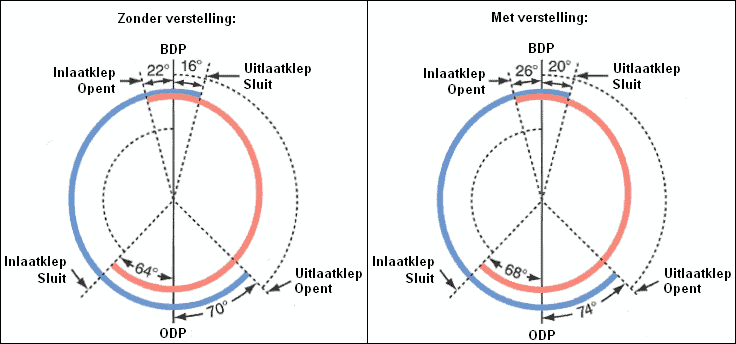
Car manufacturers are always looking for a compromise. Variable valve timing adjusts the camshaft to the required position at the engine speed at which the engine is running. The image shows two valve timing diagrams.
The left valve timing diagram shows the “normal” situation without adjustment, the right one after adjusting both the intake and exhaust camshafts. Here you can see that after adjustment the intake valve opens 4° earlier and closes 4° later. The exhaust valve also opens 4° earlier and closes 4° later.
Camshaft adjustment:
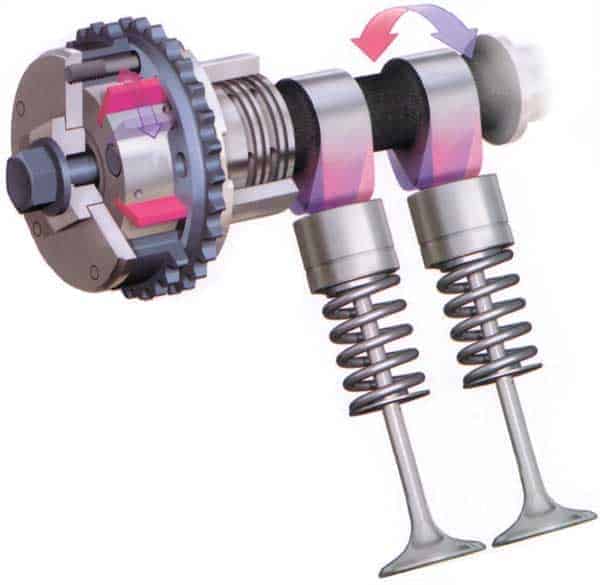
With this type of variable valve timing, the camshaft is rotated relative to the gear that is driven by the timing belt or timing chain (see image below). This system provides earlier or later opening of the valves, but cannot control the duration that the valves remain open, because the shape of the cam lobes remains the same. The system shown below operates hydraulically. The engine, and thus the camshaft gear as well, rotates clockwise. In the camshaft gear in the image below, 2 positions are marked where the camshaft will be located relative to the gear at rest (pink) and at full load (purple). On the lobes themselves, the positions are also marked for early opening at full load (purple) and the neutral position (pink).
In the situation of relaxed driving, i.e. low speed with low load, the valves will open later. The pink markings then apply. When accelerating hard at full throttle, the purple section applies. Oil is then pumped to the adjustment point in the camshaft gear, causing the inner section to rotate to the right. The camshaft is then rotated relative to the gear, causing the lobes to push the valves open and closed earlier.
In the image, the oil chambers in the adjustable camshaft gears can be seen. By filling the space with oil, an adjustment of the camshaft takes place. The timing gears are rotated relative to the mounting of the camshaft.
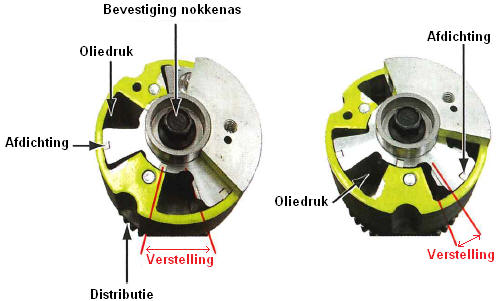
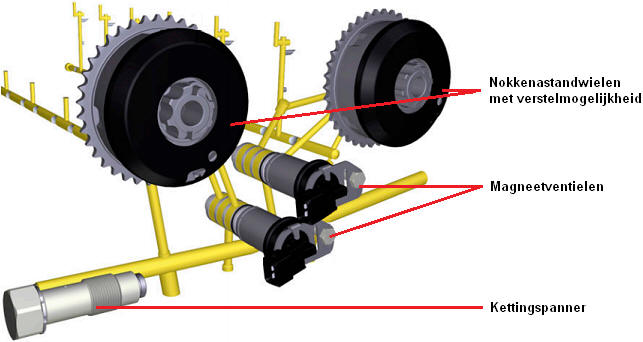
In the image, the two adjustable camshaft gears can be seen with the oil channels. The oil channels are colored yellow.
The oil pump in the oil pan supplies the solenoid valves with oil pressure. When the solenoid valves are actuated by the engine control unit (the ECU), they pass the oil pressure on to the camshaft gears. The solenoid valves therefore ensure that the camshaft gears adjust.
Possible faults in the above system include, among others:
- Solenoid valves that no longer supply the camshaft gears with oil pressure. This is often a result of contamination. The strainer in the solenoid valve can in that case be clogged with black sludge or other dirt particles. Cleaning often provides the solution.
- Camshaft gears that no longer adjust correctly. This is also often a result of contamination.
Contamination usually occurs because the engine oil is used for too long.
MultiAir:
MultiAir is a fully electronically controlled system for individually controlling the opening and closing of the intake valves via an electro-hydraulic actuator. With MultiAir, both the valve lift and the valve timing of the intake valves are controlled. MultiAir is used on both petrol and diesel engines. An adjustable camshaft is no longer required.
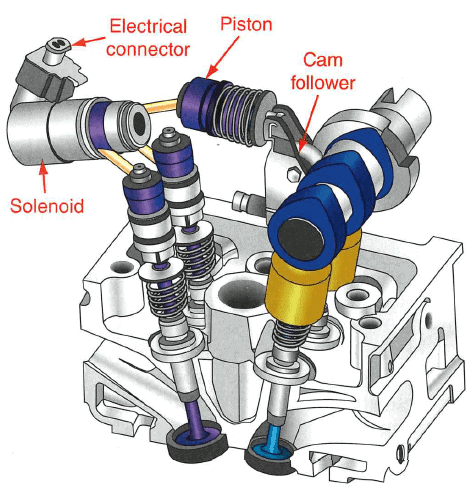
With MultiAir there is a hydraulic connection between the camshaft and the intake valve. The camshaft drives the piston of the MultiAir high-pressure cylinder via a roller finger follower. The piston in this high-pressure cylinder forces the oil towards the electronically controlled valve, also called the solenoid valve. The oil volume that is passed on to the oil chamber above the intake valves is varied by the electronically controlled valve. Less oil volume means that the intake valve opens less. This electronically controlled valve is precisely actuated by the engine control unit (the ECU). As a result, both the timing and the lift height can be precisely matched to the air demand of the engine.
When engine power is required, such as when driving at higher speeds and higher engine load, the intake valve will open fully.
During starting and idling of the engine, the intake valve will open later. There will be a high vacuum in the combustion chamber, which increases the air speed when the intake valve opens. This ensures better mixture formation and better combustion.
At medium engine speeds and partial engine load, the intake valve will close earlier. This prevents interference in the intake manifold and reduces gas exchange losses, which ultimately results in higher engine torque.
At medium engine speeds and partial engine load there is also “multilift”. With multilift, the exhaust valves are opened several times per power stroke, which benefits the quality of the combustion.
MultiAir also makes it possible to briefly open the intake valves at the end of the exhaust stroke; this adds a small portion of the exhaust gases to the intake air and creates an internal EGR.
Related pages: