Engine torque:
Engine torque is the force with which the crankshaft of the engine rotates. The torque results from the combination of the combustion force on the piston and the radius of the crank throw. The force on the piston depends, among other things, on the volumetric efficiency (air quantity) and the fuel quantity, and varies because the angle of the force transmission on the crank pin is constantly changing. We can obtain the mean effective pressure from the indicator diagram or pv-diagram.
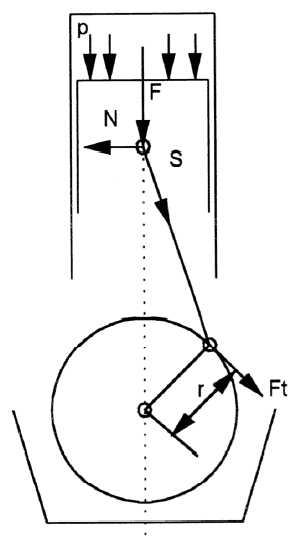
In the line drawing below we see the piston being pushed down by the combustion force (p). This combustion pressure creates force F, the piston force. The piston force is transmitted via the connecting rod (S) to the crank pin (r). This creates the so‑called tangential force (Ft).
The torque is calculated using the formula Ft x r (the tangential force multiplied by the crank radius) and is expressed in Nm (Newton metre).
Legend:
p = pressure on the piston.
F = the force on the piston
N = side thrust
S = force on the connecting rod
r = crank radius
Ft = tangential force
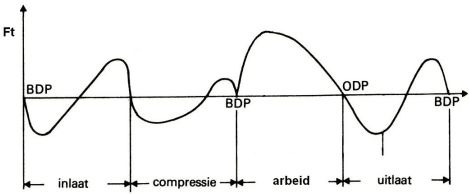
Due to the varying combustion pressure and the rotation of the crank–connecting-rod mechanism, the tangential force is also not a constant quantity. We therefore work with an average tangential force.
We can determine the tangential force when we resolve the piston force (see the image below and the page “resolving the piston force“).
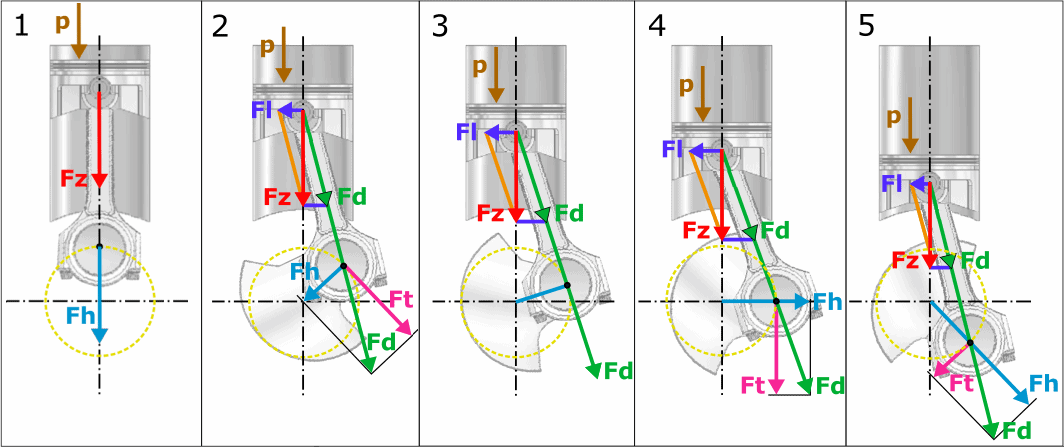
Engine torque depends solely on the force on the piston, because all other quantities such as the piston diameter and the crank radius are fixed engine data. The force on the piston (Fz) is caused by the combustion pressure (p) and depends on the volumetric efficiency of the engine (with stoichiometric air‑fuel ratio). It is mainly the restriction in the intake manifold that determines the volumetric efficiency of the engine.
The greatest restriction is caused by the position of the throttle valve. The throttle position therefore has the greatest influence on the engine torque: after all, we influence the engine performance by changing the throttle position. In a test setup, we measure the maximum torque delivered with the throttle fully open.
The torque at different engine speeds with the throttle fully open is not the same everywhere. As a result of changing gas velocities and fixed valve opening angles, the torque will only be optimal at a certain engine speed.
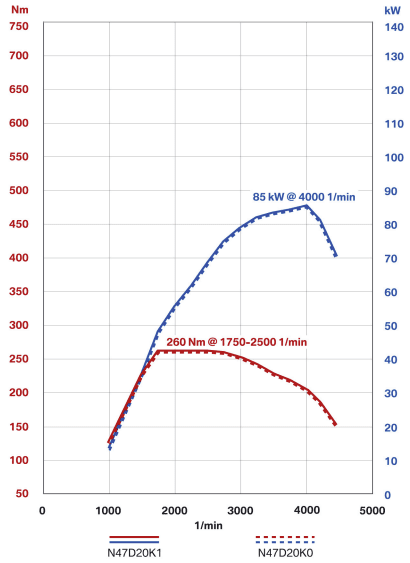
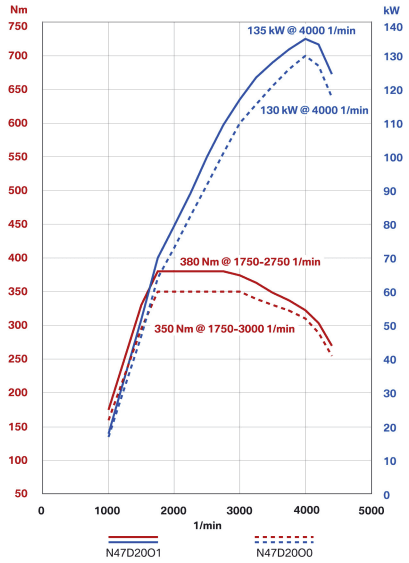
In the images below we see the power and torque curves of two types of diesel engines used in the BMW 3‑series (E9x). In both engines the torque peak is reached at about 1800 rpm, but it is clearly higher in the 320d than in the 316d. Both engines have a displacement of 2.0 litres. The higher torque has been made possible, among other things, by turbocharging, valves in the intake manifold and the mapping of the engine management system, which, in addition to the torque, is decisive for fuel consumption and exhaust emissions.
Engine power:
In the factory specifications, engine power is stated in addition to engine torque. Engine power is the product of engine torque and engine speed. Power is essentially how many times per second the torque can be delivered. The official formula is:

where P is the power in Nm/s or Watt, M is the torque in Nm and ω (omega) is the angular velocity. For torque the letter T is also often used instead of M.
Because the angular velocity (ω) is equal to 2 * π * n, where n is equal to the number of revolutions per second, we can change the formula to:

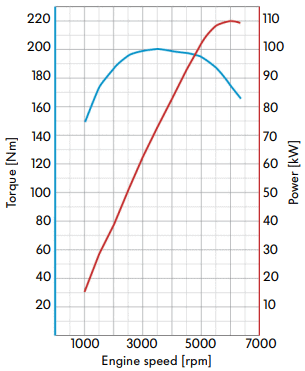
As an example, we take a naturally aspirated four‑cylinder 2.0 litre FSI engine with four valves per cylinder from the VAG group (engine code: AXW). Of course we can read off the torque and power from the graph, but in this paragraph we calculate the power on the basis of the torque.
Data:
- engine torque: 200 Nm;
- engine speed: 3500 rpm = 58.33 rev./sec.
Required: the power delivered at the given engine speed.
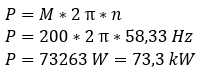
The torque and power delivered at 3500 rpm are 200 Nm and 73.3 kW.
Measuring torque and power:
Torque is directly responsible for the tractive force of the car. The torque is multiplied by the transmission ratio (i) of the gearbox and final drive, and divided by the loaded radius (rb) of the driven wheels (see the page calculating transmission ratios).
The engine torque is measured by loading the engine with the throttle fully open at different engine speeds. By loading the engine, the selected engine speed is kept constant. The braking force of the engine, multiplied by the radius of the measuring object on which the force acts, is then the engine torque.
For the power measurement, an eddy current brake can be used. In this case, the measurement takes place directly on the crankshaft. Electromagnets induce eddy currents in a metal disc, with the braking force being determined by measuring the deflection of a torsion element. During a power measurement of an engine on an eddy current brake, engine speed and torque are the measured quantities. Power is determined by calculation (see the previous paragraph).
The power of a vehicle can also be measured directly at the wheels. Losses of up to 70% must be taken into account here. These losses occur in the transmission. The axle power (the power measured at the wheels on a chassis dynamometer) is also called DIN hp. The power measured at the flywheel is referred to as SAE hp. SAE stands for Society of Automotive Engineers. The SAE value will therefore always be higher than the DIN value.
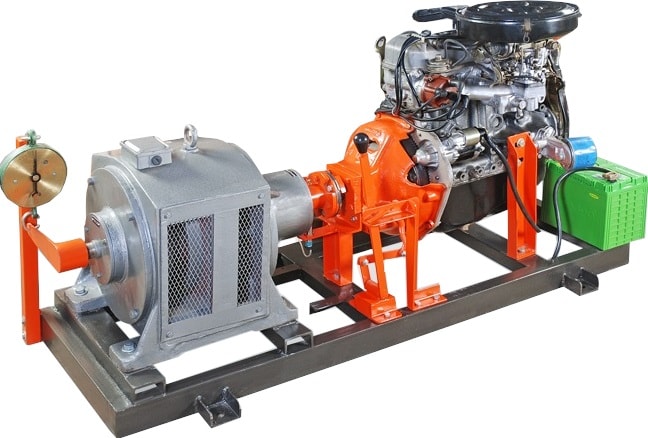
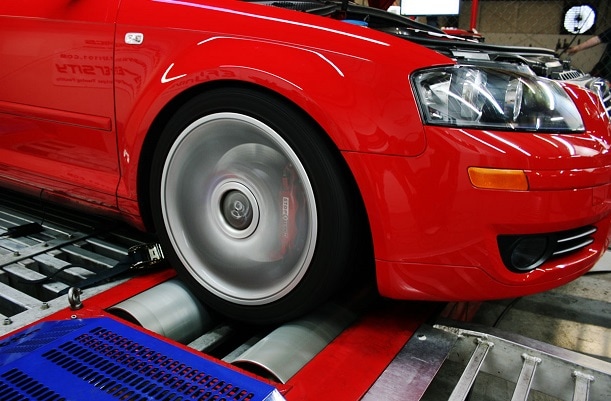
The metal rollers of the test bench are connected to a braking mechanism, usually an eddy current brake. The force with which the rollers are braked, together with the speed of both the wheels and the crankshaft, is used to measure the torque delivered and to calculate the power. The measurement is usually carried out in the highest or second-highest gear with the accelerator pedal fully depressed. A loss of 15 to as much as 30% is not unusual for two‑wheel‑drive vehicles. The computer of the chassis dynamometer compensates for this loss by measuring how much power it takes for the dynamometer to drive the vehicle. During this measurement, the vehicle coasts with the clutch depressed.
Designers or tuners try to keep the torque curve as flat as possible, so that the engine torque remains the same over as wide an engine speed range as possible. Especially engines with forced induction (turbo / supercharger), which greatly increase torque, can be tuned to be as flat as possible in this way. Also by using techniques that increase volumetric efficiency, such as multi‑valve engines, variable valve timing or a variable intake manifold, the torque band can be kept as flat as possible.
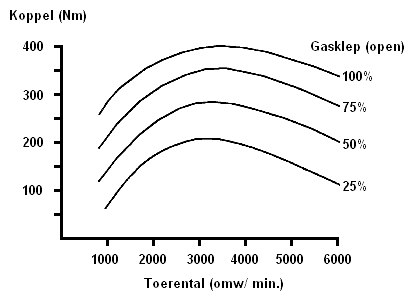
If we were to measure the torque at different throttle positions, we would obtain a curve like in the following image. However, such a measurement is rarely carried out.
Horsepower (hp) and kilowatt (kW):
To express the power output of a vehicle, the units “horsepower” and “kilowatt” are used. The power depends on the torque per second. The definition of horsepower dates back to the time when transport was still by horse and carriage. If a mass of 75 kilograms is lifted vertically over a distance of 1 metre within 1 second, a power of 1 hp is delivered. So 1 hp is 75 kg * 1 metre / 1 second.
When we look at power in the unit Watt, 1 Watt is a multiplication of 1 Newton * 1 metre per second. We abbreviate this as [1 Nm / sec].
The horsepower (pk) used in the Netherlands is exactly the same as the German Pferdestärke (PS) and the French Cheval-Vapeur (CH).
1 pk = 0.7355 kW
1 kW = 1.3596 pk
The English / American horse power (hp) is larger.
1 hp = 0.7457 kW
1 kW = 1.3410 hp
When converting horsepower to Watt, we must multiply the mass by the gravitational acceleration: 1 PK = 75 kg/sec * 9.81 m/s^2 = 7355 W = 0.7355 kW.
To convert the power of an engine with 150 hp, we multiply the number of kg/sec by the number of hp. This results in: (150 * 75) * 9.81 = 110.4 kW.
We can also convert the power in Watt to horsepower. We do this as follows: 1 / 0.7355 (W) = 1.36 hp. An engine with a power of 92 kW delivers according to the calculation: (1 * 92) / 0.736 = 125 hp.