Introduction:
When fossil fuels are burned, carbon dioxide (CO2) is released. This CO2 accumulates in the atmosphere. When sunlight hits the earth, the heat radiation can no longer escape due to the CO2 build-up, which causes the “greenhouse effect”. 120g CO2 / km corresponds to:
- 5.2 l petrol / 100 km
- 4.5 l diesel / 100 km
- 4.4 kg natural gas / 100 km
- 1.0 kg hydrogen / 100 km
- 20 kWh electricity / 100 km
With hybrid technology, CO2 reduction (emissions) is improved. Manufacturers are currently working hard on developing more and more technologies to enable an energy transition towards CO2-neutral driving.
Vehicles with hybrid drive use both the combustion engine and an electric motor. The purpose of hybridisation is mainly to reduce fuel consumption and exhaust emissions. Additional benefits thanks to the electric motor(s) are higher torque and more comfort.
With hybrid drivetrains, a distinction is made between micro-hybrid, mild-hybrid and full-hybrid vehicles.
A vehicle with fully electric drive does not fall under the “hybrid” category. A vehicle equipped with a range extender can be classified under the heading “series hybrid”.
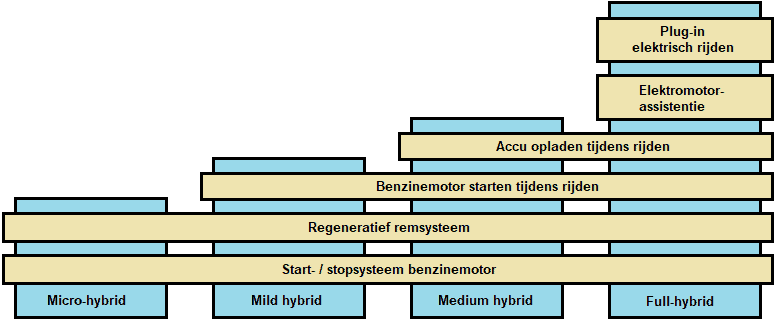
The diagram below shows the different hybrid types from a low to a high level of electric assistance and/or drive.
Micro hybrid:
A micro-hybrid vehicle does not have an electric motor to support the combustion engine while driving, but is equipped with various fuel-saving technologies. There is therefore no HV (High Voltage) system present here. The fuel saving is achieved by means of the start / stop system, which automatically switches the engine off and starts it when the vehicle is stationary, and a regenerative system for the battery. This regenerative system lets the alternator charge at maximum output when the vehicle is braking. The energy that would normally be lost in the brake pads is now partly used to charge the 12-volt battery. As a result, when driving at a constant speed, no extra fuel injection is needed to cover the increased load of the alternator and fuel is saved.
Mild hybrid:
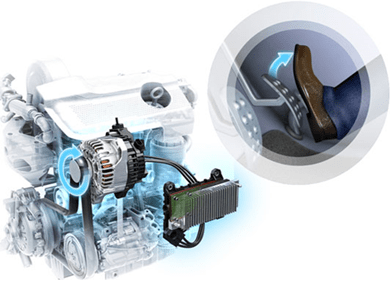
In mild-hybrid vehicles, the combustion engine is supported by one or two 48-volt electric motors that provide additional power under various operating conditions. The electric motor assists the combustion engine during acceleration. When driving at a constant speed, the electric motor is automatically switched off again. The vehicle therefore cannot drive fully electrically.
The electric motor is located near the flywheel, or there is a chain / toothed-belt drive between the electric motor and the end of the crankshaft. The relatively compact 48-volt battery is usually located in the luggage compartment.
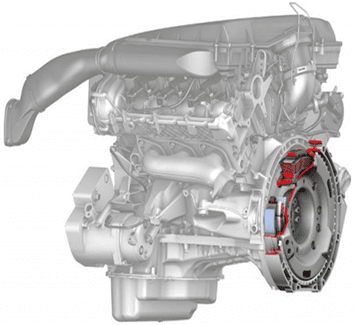
The image shows an electric motor in the flywheel housing of the combustion engine. Here too, there is no HV system. A technician without an NEN certificate is therefore allowed to work on the electric drivetrain.
A micro-hybrid vehicle can also be equipped with a 48-volt starter-generator, which is essentially a combination of an alternator and a starter motor. Manufacturers use the following names for this type of starter-generator:
- Dynastart;
- Starter generator;
- Belt driven starter-alternator;
- Belt integrated starter-generator (BSG).
With the help of a mechanism, the multi-rib belt can be tightened on the correct side, depending on whether it is charging or starting.
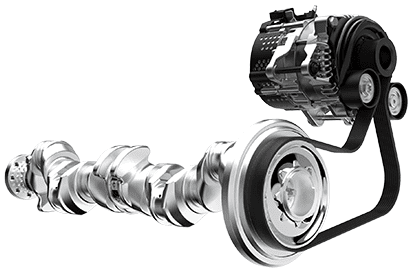
The three images below show the three possible positions when (regeneratively) charging the battery, starting the combustion engine and the electric motor mode, in which it supports the combustion engine. In turbocharged engines, the assistance mainly takes place in the low speed range, where the “boost” of the electric motor compensates for the so-called turbo lag.
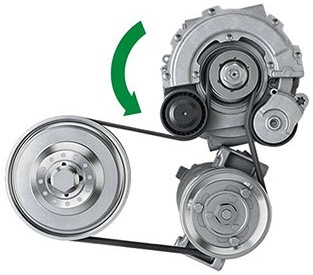
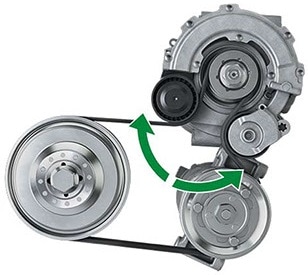
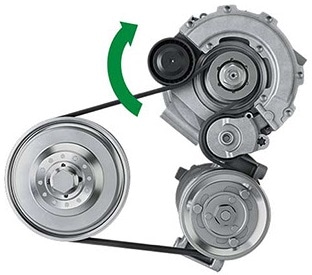
A 48-volt starter-generator replaces the “normal” 12-volt alternator. In addition to the 48-volt battery, there is also the 12-volt battery for the on-board network, which supplies energy to the lighting, door locks and accessories in the car. A DC-DC converter / converter (transformer) converts 48 volts to 12 volts in order to charge the battery.
Series hybrid:
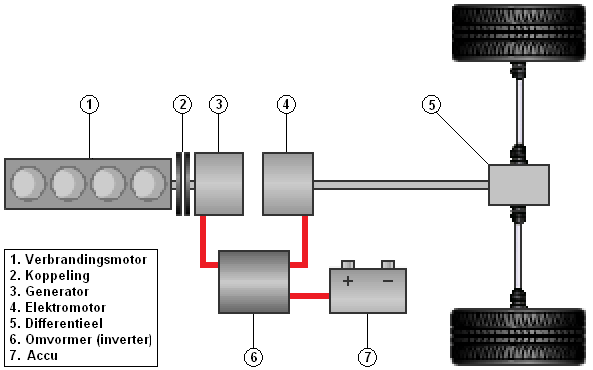
A vehicle with a series hybrid drivetrain is driven exclusively by the HV electric motor. There is no direct connection between the combustion engine and the wheels. The image below shows an example of a rear-wheel drive series hybrid car.
Between the combustion engine (1) and the generator (3) there is a clutch (2). When the engine is running and the clutch is engaged, the HV battery (7) is charged by means of the generator (3) and the converter, i.e. inverter (6). The inverter regulates the AC voltage supplied by the generator down to a regulated DC voltage.
The electric components in the drivetrain of a series hybrid operate at high voltage (HV). This can be recognised by orange cables and connectors. Only certified technicians are allowed to work on the HV system.
Advantages of a series hybrid system:
- Simple construction because the combustion engine does not directly provide the drive.
- Suitable for fully electric driving, if the battery is large enough.
- No clutch needed to move off from standstill; the electric motor takes care of this.
- No reverse gear needed because the electric motor can rotate in two directions.
- Suitable for being charged from the mains (plug-in).
Disadvantages:
- The electric motor must provide the full drive power.
- Greater mass than a vehicle with parallel drive.
Parallel hybrid:
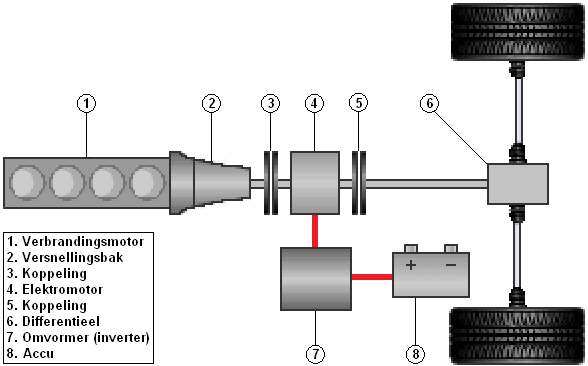
In a vehicle with a parallel hybrid drivetrain, there can be a direct connection between the combustion engine and the wheels. When the clutches (3 and 5) in the image below are engaged, the vehicle can be driven by the combustion engine. The electric motor (4) is used both for charging the battery and for driving the wheels.
A parallel hybrid can also drive on the electric motor only. By opening clutch 3, the connection to the combustion engine is broken; it can be switched off so that purely electric driving is possible. Clutch 5 is engaged when moving off from standstill.
Just like the series hybrid, the parallel hybrid is equipped with an HV installation with orange cables and connectors.
Advantages of a parallel hybrid system:
- Suitable for fully electric driving, provided the battery is large enough and there is a clutch between the combustion engine and electric motor.
- No reverse gear needed because the electric motor can rotate in two directions.
- Suitable for being charged from the mains (plug-in).
- Smaller combustion engine, because the electric motor assists during acceleration.
- Smaller electric motor, because the combustion engine can assist during acceleration.
- Lower mass than a vehicle with series drive.
Disadvantages:
- Mechanically complex.
- Clutch needed for electric take-off.
- Gearbox required.
Plug-in hybrid:
The battery of a hybrid vehicle is normally charged by regenerative braking, or by having the combustion engine drive the electric motor (which is then used as a generator). The latter is of course not efficient.
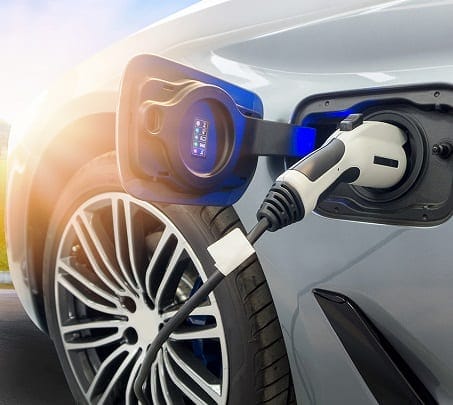
With a plug-in hybrid, the battery pack can be charged by connecting the vehicle with a plug to a household socket or a public charging station and charging it from the power grid. When setting off in the car, the first kilometres can be covered electrically (thus emission-free). This is ideal when driving from the city to the motorway. As soon as the SOC (State Of Charge), i.e. the state of charge of the battery, becomes low, the combustion engine will start and provide the main drive. When braking, the battery will again be partially recharged through regenerative braking.
An additional advantage is that the electric auxiliary heater and/or air conditioning can be programmed for a preset time, so that you get into a pleasant interior climate without this being at the expense of battery capacity or fuel.
A plug-in hybrid in most cases has a limited electric range of 40 to 60 km. Examples are:
- BMW 225XXE Active Tourer (2021): 55 km;
- Hyundai Ioniq (2021): 52 km;
- Mitsubishi Outlander PHEV model year 2015: 43 km and model year 2021: 54 km;
- Volkswagen Passat GTE Business plug-in hybrid (2021): 55 km.
Please note: these are the manufacturer’s figures. In unfavourable conditions, such as low temperatures or an unfavourable driving style, the range can decrease by as much as 30%.
Energy recuperation:
During acceleration, the battery supplies electrical energy to the electric motor. At the moment the vehicle decelerates (brakes), the electric motor will start to generate; the electric motor will then charge the battery. This is also called “regenerative braking” or “recuperative braking”. You can find more information about this on the pages about the inverter and the electric motor.
System overview Toyota Prius:
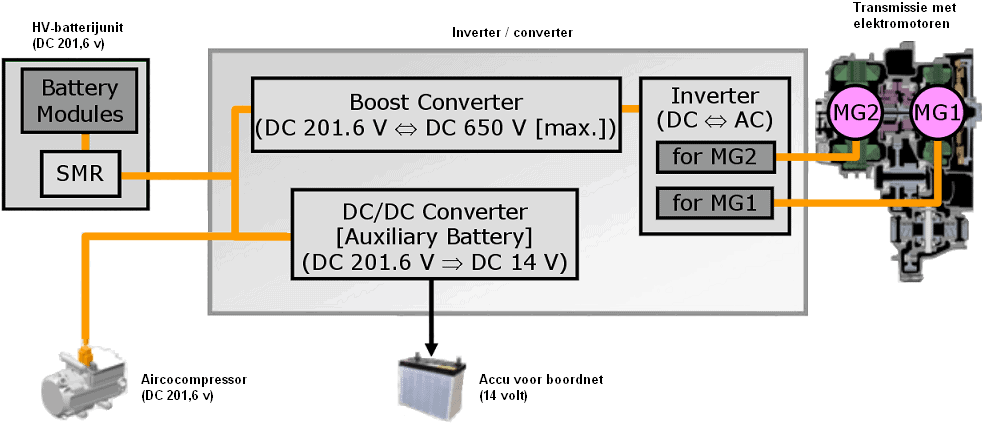
The battery of a Toyota Prius stores a DC voltage of approximately 200 volts. The boost converter converts the battery voltage of 201.6 into a higher direct current (DC) voltage of 650 volts. The boost converter is a DC/DC converter; it remains direct current, only the voltage is increased. The 650-volt DC voltage is supplied to the inverter. The inverter converts direct current (DC) into alternating current (AC) and vice versa. We therefore also refer to this converter as an AC/DC rectifier or DC/AC converter. In addition to the conversion from DC to AC, the inverter also contains the control of the electric motors by means of IGBTs. The two electric motors (MG1 and MG2) operate on three-phase alternating voltage of approximately 600 volts.
The battery voltage is not only supplied to the boost converter and the air conditioning compressor, but also to the DC/DC converter for the onboard battery. The voltage of 201.6 volts is converted to 14 volts in order to charge the lead-acid battery. The 14-volt battery supplies the electrical components of the interior and exterior, such as the radio, lighting, door locks, etc.
System overview Mitsubishi Outlander:
The following overview shows the components of a Mitsubishi Outlander (model year 2019 >).
Depending on the driving conditions, this (plug-in) hybrid behaves as an EV, series hybrid or parallel hybrid. The abbreviations are as follows:
- PDU: Power Drive Unit
- GCU: Generator Control Unit
- FMCU: Front Motor Control Unit
- RMCU: Rear Motor Control Unit
- GCU: Generator Control Unit
- OBC: On Board Charger
EV mode: during fully electric driving, the multi-plate wet clutch is disengaged and the electric motors (each with a maximum power of 60 kW) provide the drive. The petrol engine and the generator are switched off.
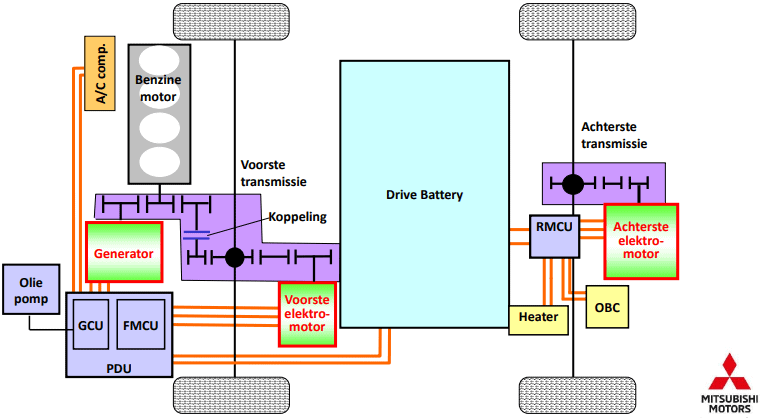
Series mode: when the battery charge is <30% and the power demand is >60%, the petrol engine and generator are started. The clutch remains disengaged. The petrol engine drives the generator, which charges the battery (and therefore does not drive the wheels). The system now behaves as a series hybrid. While driving, the petrol engine speed is approximately 1700 rpm. When accelerating and braking, the speed drops to 1100 rpm.
Parallel mode: when driving faster than 65 km/h, there is an increased power demand, or the SOC of the battery is <30%, the transmission is shifted in such a way that the parallel mode is engaged. The combustion engine and the front electric motor drive the wheels. The speeds of the combustion engine and the front electric motor are synchronized before the clutch is engaged. In parallel mode, the rear electric motor is controlled up to 5% to prevent magnetic field resistance at high speeds when running without load.
Transmission of a hybrid vehicle:
Most manufacturers (Ford, Honda, GM) use CVT technology (Continuously Variable Transmission) as the transmission in their hybrid models as of 2019.
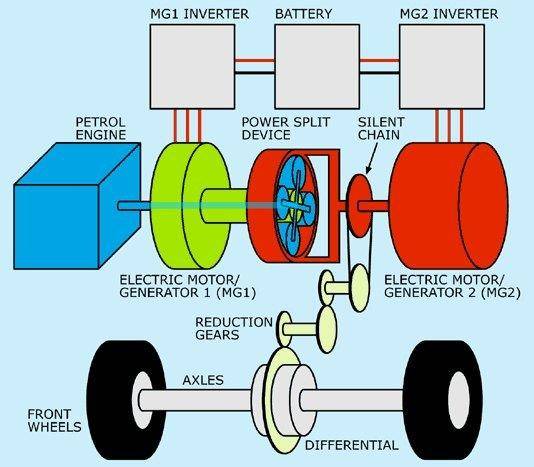
The CVT technology of the Toyota Prius (see image) is not achieved by means of a push belt and diameter-adjustable pulleys, but by an electrically controlled combination of electric motor, generator and planetary gear set. The advantage of this type of transmission compared to the mechanical CVT is that it is not subject to wear and weighs considerably less.
The illustrated Prius drivetrain consists of:
- combustion engine (petrol engine);
- electric motor MG1 (acts as generator/dynamo during regenerative braking);
- electric motor MG2 (the drive motor);
- planetary gear set (Power Split Device) that can couple and decouple the combustion engine and electric motor from the drivetrain;
- chain drive to gears connected to the differential.
Related pages: